“No Amnesty, No Silence:” Ukrainian Women Urge Accountability for War-Time Sexual Violence

Last week, the Georgetown Institute for Women, Peace and Security (GIWPS) brought a delegation of four Ukrainian women leaders to London to advocate for justice, accountability, and sustained international support for survivors of conflict-related sexual violence that has been perpetrated as a tactic of war by the Russian army in Ukraine.
Against the backdrop of President Zelensky’s visit to Downing Street and ongoing U.S.-led talks with Russian and Ukrainian officials on a potential peace framework, the GIWPS delegation met with key members of the UK Parliament and government at a private event held at Westminster organized by Baroness Helena Kennedy that underscored sexual and reproductive violence as tools of genocide. This was followed by a private briefing for Members of the House of Lords, organized with the support of Baroness Mary Goudie.
The delegation also held meetings with key UK stakeholders, including officials at the Foreign, Commonwealth & Development Office (FCDO), the Overseas Development Institute (ODI), and several journalists. During these meetings, the delegation emphasized the importance of flexible funding for survivor-led initiatives and urged sustained political commitment to two key priorities: first, ensuring that a portion of the frozen Russian sovereign assets is used specifically to fund reparations for survivors of Russian war crimes; and second, ensuring that the immunity clause is not included in any peace agreement between Russia and Ukraine. Following these meetings, prominent British war correspondent Christina Lamb published a moving article in The Times, highlighting the calls to action and urgent needs of survivors.
The centerpiece of the advocacy trip to London was a screening of excerpts of the forthcoming film, Traces. Directed by Alisa Kovalenko and featuring stories of six courageous Ukrainian women survivors, the film sheds light on both the scale and toll of the Russian invasion and the extraordinary resilience of survivors. The event was attended by Her Royal Highness The Duchess of Edinburgh GCVO who opened the event with a heartfelt message of solidarity with all survivors of conflict-related sexual violence (CRSV), underscoring the urgent need to reduce stigma and ensure survivors are supported, believed, and able to recover fully.
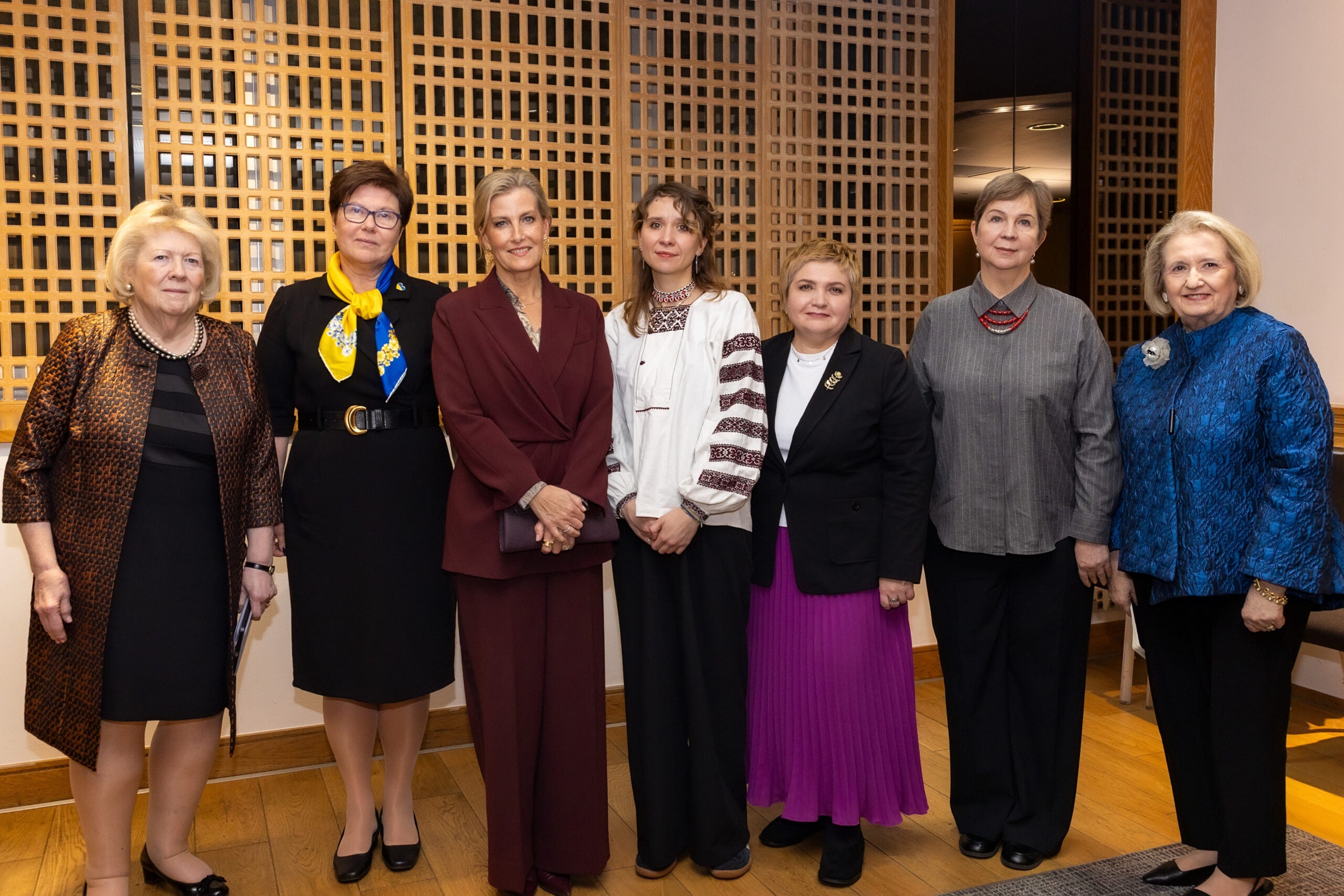
The film screening was followed by a high-level panel discussion examining survivors’ lived experiences alongside ongoing efforts in justice, policy, and frontline documentation, moderated by GIWPS Executive Director Melanne Verveer. Reflecting on the origins of the film, Kovalenko recalled the first meeting of the SEMA Ukraine survivor network: “We were twelve women, and even then we discussed creating a documentary.” As an award-winning filmmaker, she emphasized the power of cinema to transform pain—not only into healing, but into a tool for accountability. “To see women’s faces and look into their eyes creates a window of empathy,” she noted, ensuring that survivors are seen not as statistics, but as individuals whose experiences demand justice.
Survivors of CRSV must often grapple with intense stigma in the aftermath of assault; this is something SEMA Ukraine is working hard to overcome. Iryna Dovhan, Founder and Director of SEMA Ukraine, shared their hopes for the future, “to be perceived as fighters, not [as] victims.” Further, she offered a call to action to the audience: “you can fight with us, demand justice.”
Dr. Kateryna Levchenko, Ukraine’s Government Commissioner for Gender Equality Policy, echoed this call, urging a holistic, survivor-centered approach to all rehabilitation efforts aimed at investigating and addressing these crimes. She also noted the importance of the international community holding Russia accountable. Central to this, according to Levchenko, is adding Russia to the UN Secretary-General’s so-called “Shame List,” which identifies countries responsible for committing CRSV and bans them from participating in UN-mandated peacekeeping missions. Levchenko’s work, alongside survivors’ efforts, has prompted the UN Secretary-General to warn Russia that it could be added to the list next year if conditions do not change. As Levchenko noted, “It is not perfect, but it is still a victory.”
Natalia Karbowska, Director of Strategic Development at the Ukrainian Women’s Fund–a major donor to smaller service-providing organizations in Ukraine–emphasized the importance of localizing funding and support for survivor-led organizations. As a development expert, Karbowska noted that larger organizations often dominate funding opportunities, sidelining community-level groups like SEMA. She called for an approach that centers localization, “to work where people live [and to] empower those who have suffered.” Karbowska also highlighted the need for greater cross-sectoral alliances and political will to sustain and support survivor-led initiatives, work on documentation of crimes, and advocate for accountability..
The panelists themselves were a powerful representation of cross-sectoral partnership in advancing a common cause. They have been collaborating on international advocacy and survivor support initiatives since the full-scale Russian invasion of Ukraine. The Ukrainian Women’s Fund and the Government Commissioner collaborated on the publication of an advocacy book, which features survivors and activists engaged in this issue, including Alissa Kovalenko and Iryna Dovhan. Karbowska and Dr. Levchenko presented the book, Ukraine Is Not Silent: Chronicles of Fighting Against War-Related Sexual Violence, to Her Royal Highness The Duchess of Edinburgh during a private meeting prior to the film screening. Her Royal Highness expressed her gratitude for the book and shared that her heart was heavy that such a publication was necessary.
When asked, “what can we do?” Iryna Dovhan requested the audience purchase power banks for survivors who spend many hours of their day in darkness due to Russian aggression, and for gift cards, so survivors can buy food for their families for Christmas. “It’s the simple things,” said Dovhan, “but it lets survivors know that we are not alone.” Ambassador Verveer reflected on early conversations with the director, stating, “Alissa’s dream was to show the film in places like this, to people like you.” Click here to learn more about ways to support SEMA Ukraine and the Ukrainian Women’s Fund.
Explore More

Wellbeing of women goes hand in hand with wellbeing of nations
International Women’s Day amid gender backlash: defending Women, Peace and Security at…
GIWPS Analysis: U.S.–Israeli Attacks on Iran
The U.S.–Israeli attacks on Iran this weekend have been met with a…