Eyes on North Kordofan: The Current Epicenter of Sudan’s War, as Risks for Civilians Become Dire

North Kordofan state is currently the epicenter of Sudan’s complex conflict. Hundreds of thousands of civilians in the state have fled large towns such as Bara and Om-Rowaba, and rural areas have emptied due to escalated fighting, drone strikes, and risks of attacks on civilians. El-Obeid, the state’s capital and largest city, is currently under daily drone attacks targeting civilian infrastructure such as hospitals, gas stations, and schools, and the UN Security Council recently warned of “the imminent risk of mass atrocities.” Hundreds of thousands of civilians in El-Obeid, including 105,000 displaced people, are under threat, and nearby Bara, which lies only 45 minutes away and links El-Obeid and Khartoum, is not only under siege but has witnessed massacres by the Rapid Support Forces (RSF) over several periods in the last three years. The UN Human Rights Council held a debate last week, during which the UN’s High Commissioner for Human Rights, Volker Türk, called for urgent action to stop the heavy fighting that has led to a massive humanitarian crisis. Mr. Türk noted that the “red alert” being issued for El Obeid must “land on the desks of Heads of State and Governments around the world”.
This article attempts to offer an overview of how the war impacts the people of North Kordofan, especially women, and the significance of the latest developments for the war’s trajectory. The article calls on the international community to move beyond rhetorical condemnation and provide the necessary civilian protection for women and children before another tragedy unfolds.
Background
El-Obeid city is one of the oldest and most prominent cities in contemporary Sudan. Called the “Bride of the Sands,” it is strategically located in Sudan’s center, and due to this position, it serves as an administrative and commercial hub that bridges North and Central Sudan with Western Sudan, including most of the Kordofan and Darfur regions. Historically, trade flowed from Omdurman through El-Obeid to Western Sudan. In recent years, however, the same route has reversed in function: the export road linking Omdurman to El-Obeid has become a critical lifeline, now carrying trade and exports that arrive in Omdurman before heading east to Sudan’s port on the Red Sea.
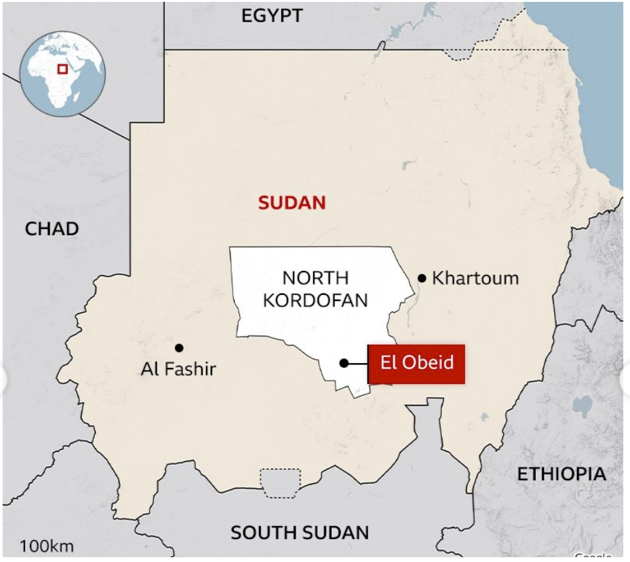
The city’s strategic location made it one of the earliest flashpoints in the current conflict in Sudan. On 15 April 2023, shortly after fighting broke out between the Sudanese Armed Forces (SAF) and the Rapid Support Forces (RSF), El-Obeid airport became a battleground. The two forces clashed for several days before the SAF repelled repeated RSF assaults and pushed the group out of the city. However, the RSF remained positioned around El-Obeid, and between April 2023 and February 2025, the city was officially under siege and cut off from the rest of the country as Sudan’s capital, Khartoum, was burning. Between February and May 2025, the SAF reclaimed several cities and towns in North Kordofan as well as Central Sudan, including Khartoum. The liberation of Khartoum automatically pushed back the frontlines of the conflict, and North Kordofan—along with Western and Southern Kordofan—became embroiled in armed confrontations and consistent drone attacks. As a result, throughout the war, Kordofan has seen massive civilian displacement, with nearly 1 million displaced persons, many of whom fled to El-Obeid. The state has also recently seen large-scale displacement of people leaving Kordofan and moving toward Omdurman and White Nile state due to risks, even as it has itself become a destination for internally displaced people (IDP) fleeing other parts of Kordofan and the Darfur region.
Sudan’s war has recently evolved into a war of technology. As ground offensives stalled and the forces hemorrhaged thousands of young soldiers over the last three years, both the SAF and RSF shifted their focus to drones and air defence systems. UN officials estimate that drone strikes killed over 1,000 civilians in just the first five months of this year alone, accounting for the large majority of conflict-related deaths. The UN High Commission for Human Rights recently noted, “armed drones have now become by far and away the leading cause of civilian deaths.”
The Current Situation in El-Obeid
The RSF is significantly increasing its military build-up close to El-Obeid, and the city is encircled from at least two directions. This has led to the deployment of troops to the city, which once buzzed with life. Early this year, a girl’s school was bombed, drone attacks have intensified in recent weeks, and the Al-Obeid power station—the city’s main electricity hub—was hit. The population has experienced blackouts, shut down water pumping, and impacted hospitals. Schools, fuel stations, hospitals, and even private homes were hit with drones, leading to the direct deaths of dozens of civilians and likely hundreds who are impacted by the deteriorating health situation and hunger.
Moreover, similar to other cities around Sudan that are under siege or bombardment, leaving the city has become dangerous as well as very expensive for civilians seeking to flee the violence and harsh living conditions. This means civilians are trapped due to insecure roads leading out of the city, the cost of leaving, and the fact that civilians have not been making a steady income for months, if not years. Recent reports estimate that at least half a million people live in the city, and it is now hosting an additional 100,000 IDPs who have fled violence in Western Sudan.
For women-led organizations on the ground, these crises are affecting their peacemaking efforts. Across many states, women’s groups are managing complicated social services, from managing soup kitchens to supporting survivors of conflict-related sexual violence and documenting the lived experiences of women. This work comes at great risk. In May 2026, Sara Mohamed Ahmed, the coordinator of the feminist response rooms in Al-Dillinj city in Southern Kordofan state, was killed in a drone attack.
On June 20, the UN Security Council issued a statement demanding the RSF halt its assault, and UN High Commissioner Türk said, “We have seen this playbook before. We cannot allow the repeat of the preventable atrocities we documented in al-Fasher and Zamzam IDP camp in North Darfur last year.” The Coalition for Atrocity Prevention and Justice for Sudan, which has at least 20 member countries, has also warned that “Sudan’s paramilitary Rapid Support Forces (RSF) could imminently escalate an assault on the central city of el-Obeid.” Many experts and organizations, including the UN, have highlighted the significant risk of mass atrocities for civilians in El-Obeid. Yet none of this diplomatic action has translated into change on the ground. In short, El-Obeid is likely to face a dreadful siege that could devastate its population, or, less likely, an assault modeled on what happened in El-Fasher, where an independent UN fact-finding mission said the city’s seizure showed “hallmarks of genocide.”
Why is This Important?
An increased attack on El-Obeid would be significant in two key ways:
First, it would be yet another instance of grave violations of human rights and extreme disregard for human lives and dignity, likely amounting to yet another instance of horrific mass atrocities in this Sudanese war. Women and girls would likely be disproportionately impacted by this violence, as they have been throughout this conflict, with gender-based attacks and risks including the use of rape as a weapon of war. The gendered dimension of this crisis is not incidental to the conflict; rather, it has been a documented and apparently deliberate instrument of war strategy. There is little reason to expect El-Obeid would be treated differently if the city falls.
Militarization from the SAF and allied forces, as well as RSF troops, dramatically increases risks for women and civilians. ACLED analyst Nohad Eltayeb assesses that civilians and women in particular face a serious risk of looting, sexual violence, and reprisals against those perceived to have supported the army, regardless of ethnic composition. We saw this happening in Bara, which was reclaimed by the army last year for a few days before it fell back into the hands of the RSF, which then set out to massacre at least 300 people whom they saw as supporters of the army.
The failure of the international community and parties to the Sudanese conflict to act, particularly in light of so many warning signs, and prevent these attacks on civilians would be immoral and undermine Sudan and the world’s commitments to international law and human rights.
Second, it would have key strategic implications for the overall conflict. In addition to the city being strategic, the takeover of El-Obeid and other major towns in the state would essentially mean that the RSF would control all of Western Sudan and would control a city that is only 500 kilometers from Sudan’s capital, Khartoum. This could be a dangerous development, particularly seeing that a year ago, the RSF and its allies launched what they called a “peace government,” which is essentially a parallel government that is based in Nyala, the capital of South Darfur state. Their rhetoric explained that they want to challenge Sudan’s de facto government. However, recent moves by the parallel government—such as the establishment of the Transitional Monetary Council, which acts as a Central Bank and a parallel judicial committee—put Sudan’s national unity at stake. The ethnic and regional polarization caused by the war has already eroded the country’s social fabric to the point where disintegration was a real possibility, but the establishment of a parallel government marks the point at which that disintegration begins to take institutional form. Moreover, the closeness of the conflict to Khartoum threatens to undo the mass reconstruction efforts that took place over the last year and threatens the lives and livelihoods of millions of IDPs and refugees who have returned home.
The women of El Obeid do not need more expressions of concern; they need protection before another tragedy unfolds. Protecting Sudanese civilians, including women and children, is not just a humanitarian obligation; it is essential to prevent further atrocities. The international community must move beyond statements to ensure humanitarian access, protect civilians, support local women-led organizations, and hold perpetrators accountable. Women’s groups have legitimacy because they are embedded in their communities and respond where the state has failed. Moreover, the women-led organizations offer a more inclusive alternative to traditional parties by organizing across class, age, ethnicity, and geography. Sudanese women should not be merely counted among the victims of the war, but they must be recognized as crucial partners in shaping Sudan’s future. In the short-term, women’s participation brings peace, and in the long-term, it will help undo the militarisation of the country and its takeover of men with guns.
Reem Abbas is an independent Sudanese researcher and writer.
Explore More
5 Takeaways from UNGA 81
The Georgetown Institute for Women, Peace and Security (GIWPS) recently returned from…
How the United Nations Can Address Growing AI Concerns to Peace and…
As world leaders convene in New York this week for the UN…
A World in Transition: Helen Clark on the State of the World
This week, the Georgetown Institute for Women, Peace and Security welcomed the…