Meet the New Graduates of Georgetown’s Gender, Peace and Security Certificate

This weekend, Georgetown University celebrated the class of 2026 during its annual commencement ceremony on Healy Lawn, honoring graduates whose work and leadership will shape communities and policies around the world. At the Georgetown Institute for Women, Peace and Security (GIWPS), we are especially proud to recognize the 12 students who earned our graduate certificate in Gender, Peace and Security (GPS) this academic year.
GIWPS is also pleased to announce the winners of our annual student writing awards, which bring together emerging voices from universities across the Washington, DC consortium to explore some of today’s most pressing global challenges through a gender lens.
Meet this year’s GPS graduates and writing award winners, and learn how they are advancing the future of Women, Peace and Security (WPS) through research, advocacy, and policy leadership.
Celebrating the GPS Certificate Class of 2026
GIWPS congratulates our newest GPS certificate alumni. This certificate provides Georgetown graduate students with a rigorous academic treatment of critically important issues related to gender dynamics and gendered experiences in conflict and peacebuilding.
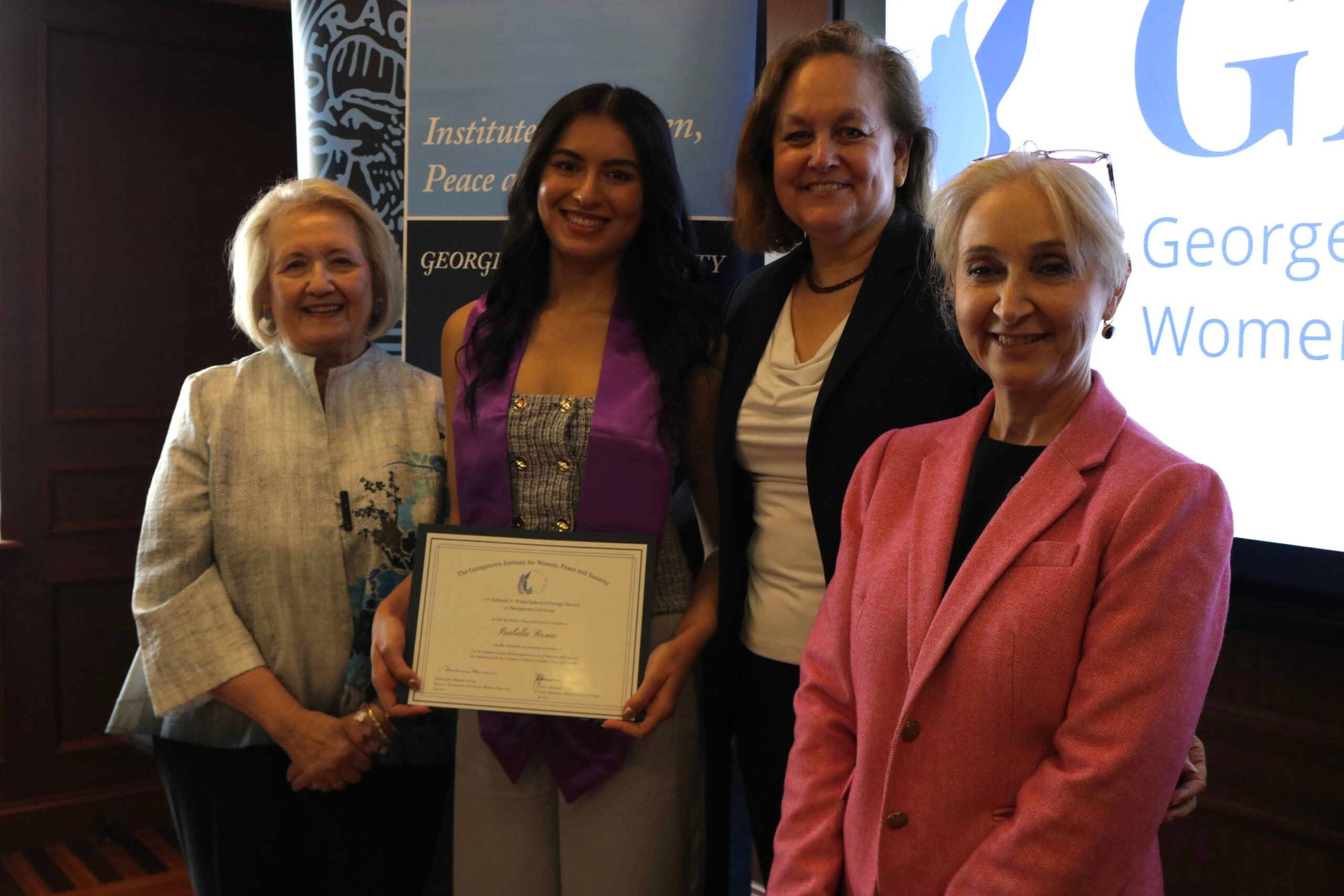
This year’s graduating cohort represents several Master’s programs across Georgetown’s campus and includes Payton Blaney, Alice Qin, Alexis Lopez, Kate Gargano, Dancy (Rui) Chen, Daniela Hernandez, Delani Pecchioli, Sasha Prevost, Ana Paula Gonzalez, Yu-Hui (Amy) Lin, Isabella Romo, and Courtney Totorica.
“This certificate program in particular is dear to my heart,” said Joel Hellman, dean of the Edmund A. Walsh School of Foreign Service, during a graduation ceremony GIWPS held for the graduates. “It draws in people with many different skills, areas of interest, and backgrounds, and brings you all together in classes so you can exchange ideas, push each other, and ask more fundamental questions about what unites us.”
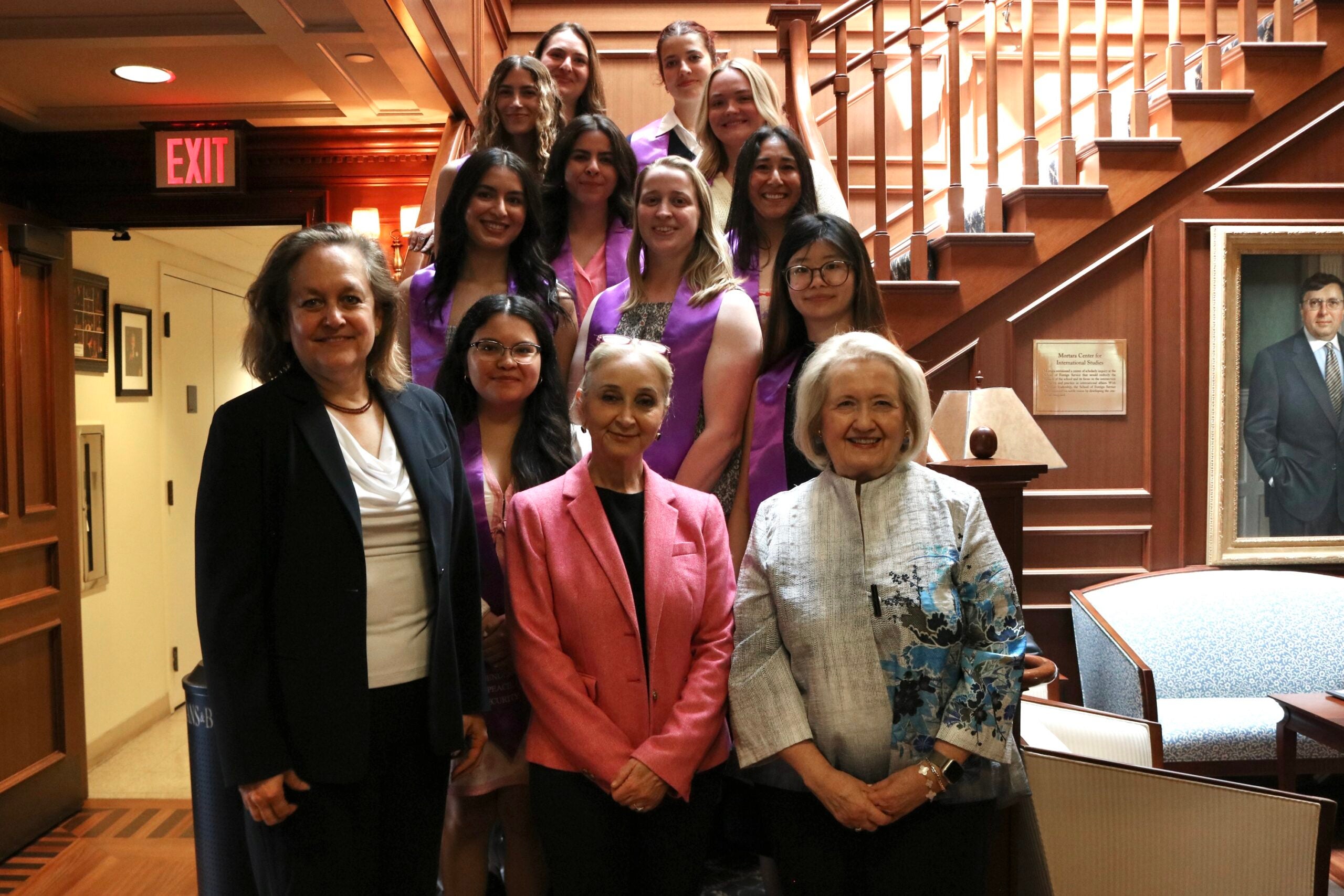
GIWPS Executive Director Ambassador Melanne Verveer, Certificate Director Dr. Ayse Kadayifci-Orellana, and Managing Director Carla Koppell joined the celebratory ceremony and luncheon alongside the graduates’ family and friends.
“As you go forward, we’re confident that you will shape a future where unity, peace, and inclusion are not just aspirations, but realities,” said Verveer.
Graduate Highlights
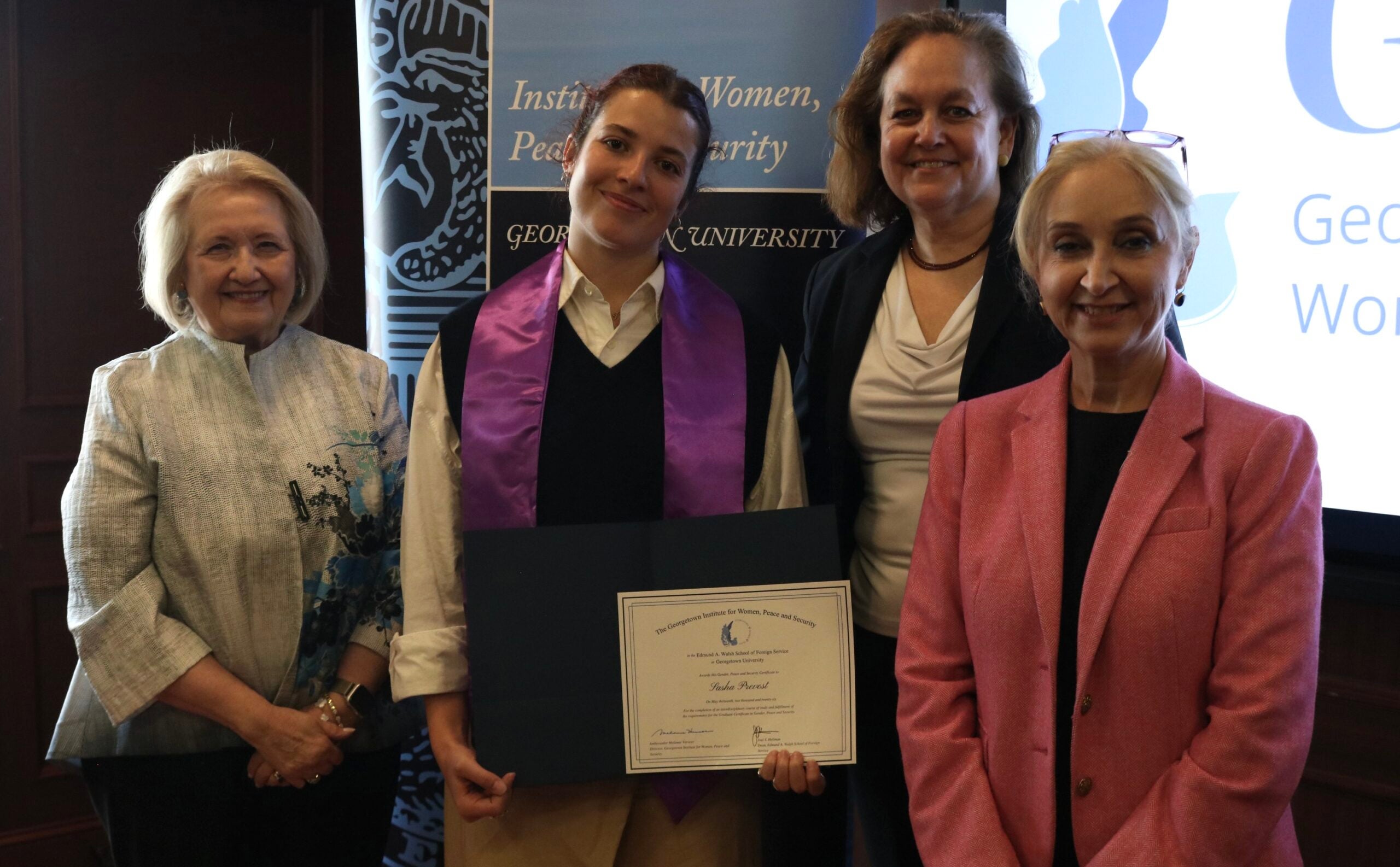
Sasha Prevost
Sasha Prevost, a graduate of Georgetown’s Security Studies Program (SSP), said she chose to attend Georgetown specifically because of the GPS certificate. Wanting to focus on WPS issues, she found the program transformative, both professionally and personally. Prevost emphasized that the certificate went beyond theory by providing practical tools for integrating diversity, equity, and inclusion principles into institutional and policy work. Following graduation, Prevost will begin a research fellowship with the NATO Association of Canada, where she hopes to continue applying the WPS framework to her research.
“I came to the certificate for the professors and quality of education, but I came out of it with, first of all, most of my friends, and renewed inspiration for the WPS agenda,” she said.
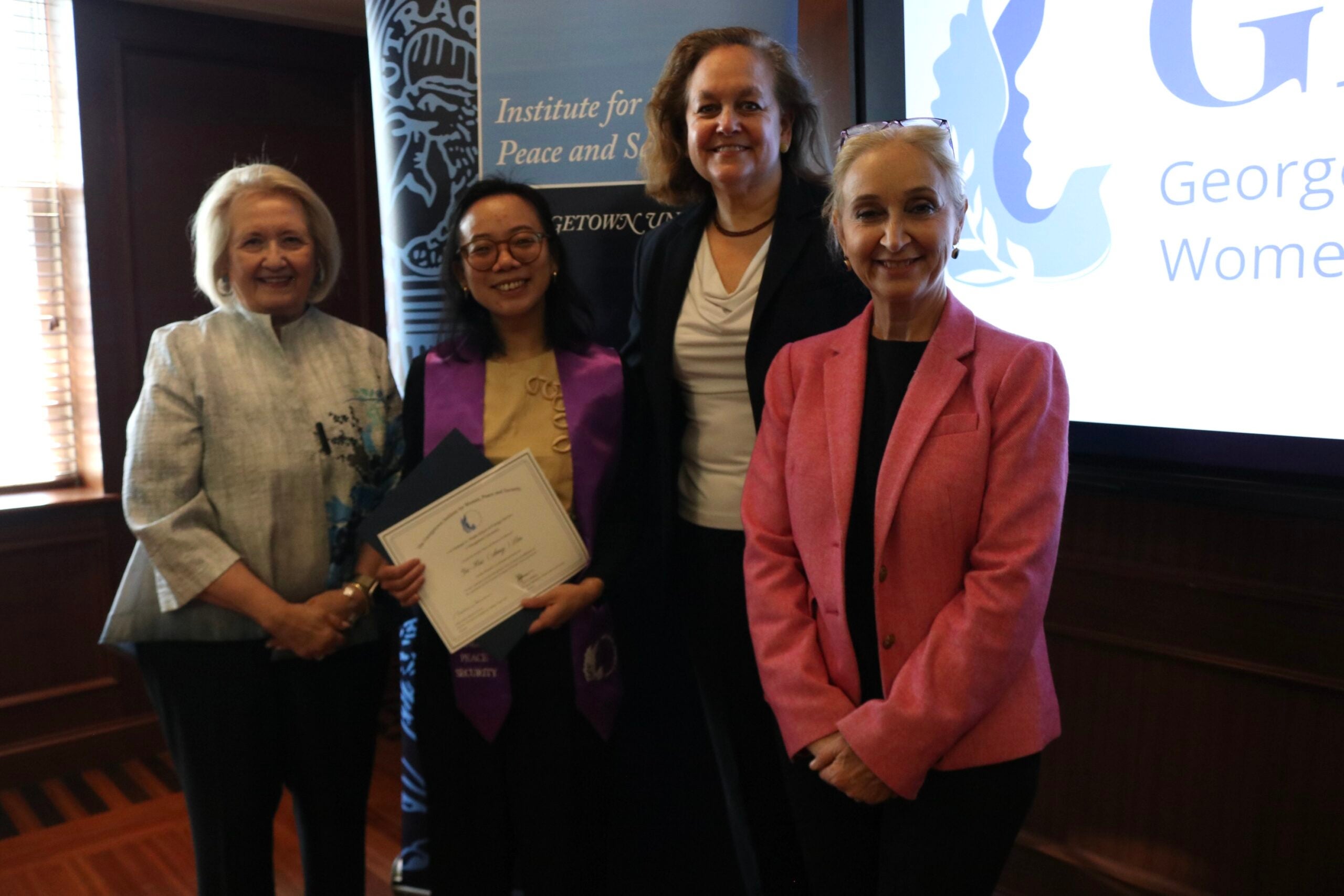
Yu-Hui (Amy) Lin
Yu-Hui (Amy) Lin, a graduate of Policy Management at Georgetown’s McCourt School of Public Policy, said she first discovered the certificate program during orientation. Drawn to the program’s people-centered approach, Lin described how courses like Gender and Security Studies deepened her understanding of how policy and community-building efforts should be rooted in lived experience. Coming from a background in community health, urban planning, and immigration, she said the certificate expanded her perspective beyond domestic policy to consider the experiences immigrants carry before arriving in the United States and how those experiences shape communities.
“I just really want to encourage folks to broaden [their studies] — even if you’re not part of the gender and security studies program,” said Lin. “This truly has been a great experience that really complements my learning journey.”
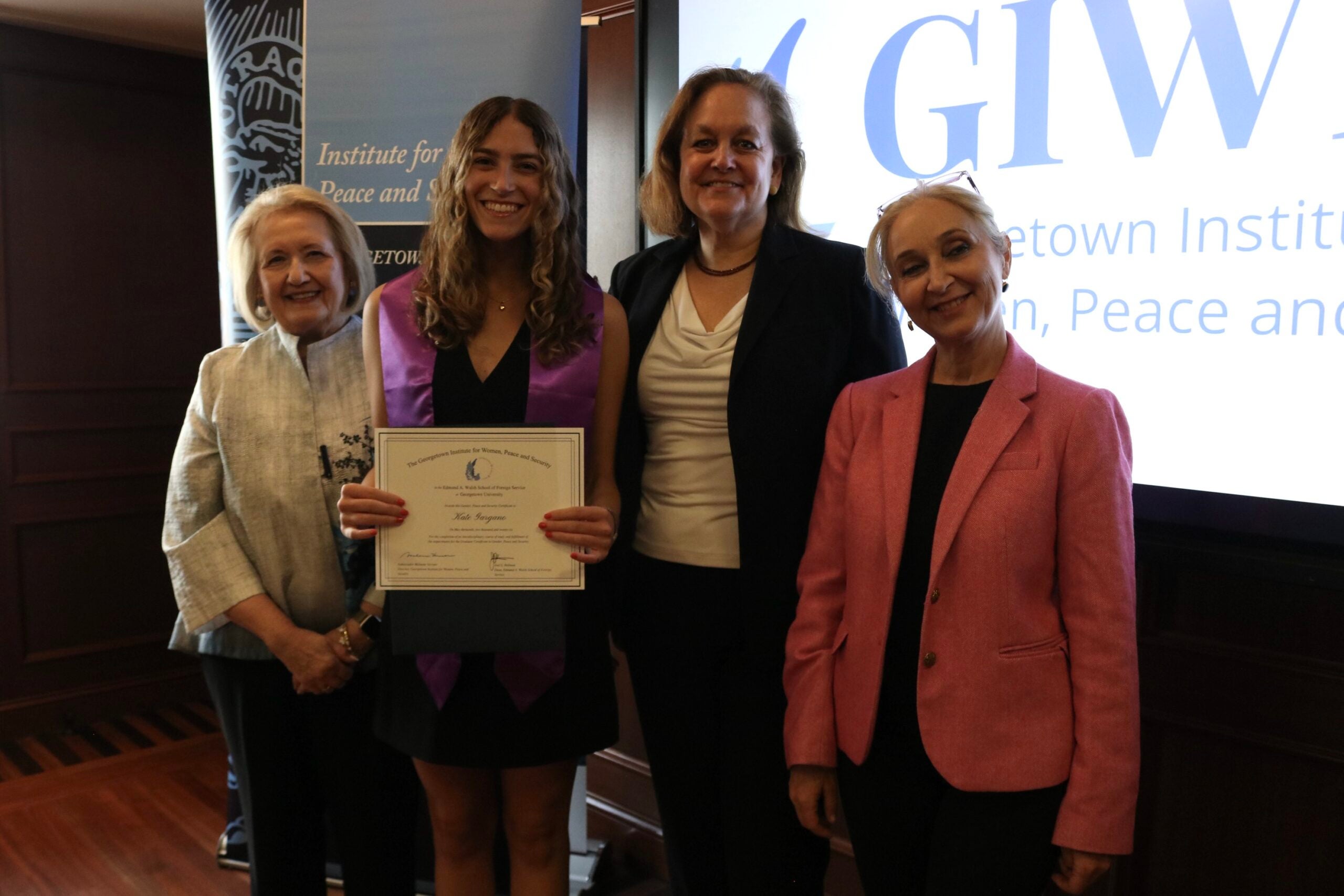
Kate Gargano
Kate Gargano, a graduate of Georgetown’s Conflict Resolution master’s program, described the certificate as a transformative part of her academic and professional journey. Through courses on gender, international security, social movements, and advocacy, Gargano developed practical skills in critical analysis, intersectional thinking, and embedding care-centered approaches into policy work. She emphasized how the certificate strengthened her commitment to uplifting overlooked voices and considering the human impact of policy decisions in all areas of her work.
“Gender mainstreaming can’t be a top-line issue. It needs to be truly embedded in everything that you’re doing,” she said. “When you have that skill set, it becomes so much easier to embed not only yourself, but that practice of care into your organization.”
Isabella Romo
Isabella Romo, a Master of Public Policy graduate from Georgetown’s McCourt School of Public Policy, pursued the certificate program to deepen her understanding of how to better protect women in global policy and security spaces. She described the certificate as a natural extension of her interests, giving her the opportunity to explore the complexities of international security and women’s human rights through an interdisciplinary lens.
“The program did a great job of providing tangible skills that are necessary for doing Women, Peace and Security work across different industries,” she said.
Honoring the 2026 Student Writing Award Winners
Each year, the Gendered Security Policy Essay Award recognizes exceptional graduate students from the Consortium of Universities of the Washington Metropolitan Area for their insightful, policy-oriented essays exploring the gendered dimensions of peace and conflict. The contest is sponsored by Our Secure Future and Mobilizing Men as Partners for Women, Peace and Security (MAWPS).
We’re proud to celebrate this year’s outstanding winners who are helping to shape the conversation around gender and security policy. Here’s what the authors of each essay have to say about the inspiration behind their work.
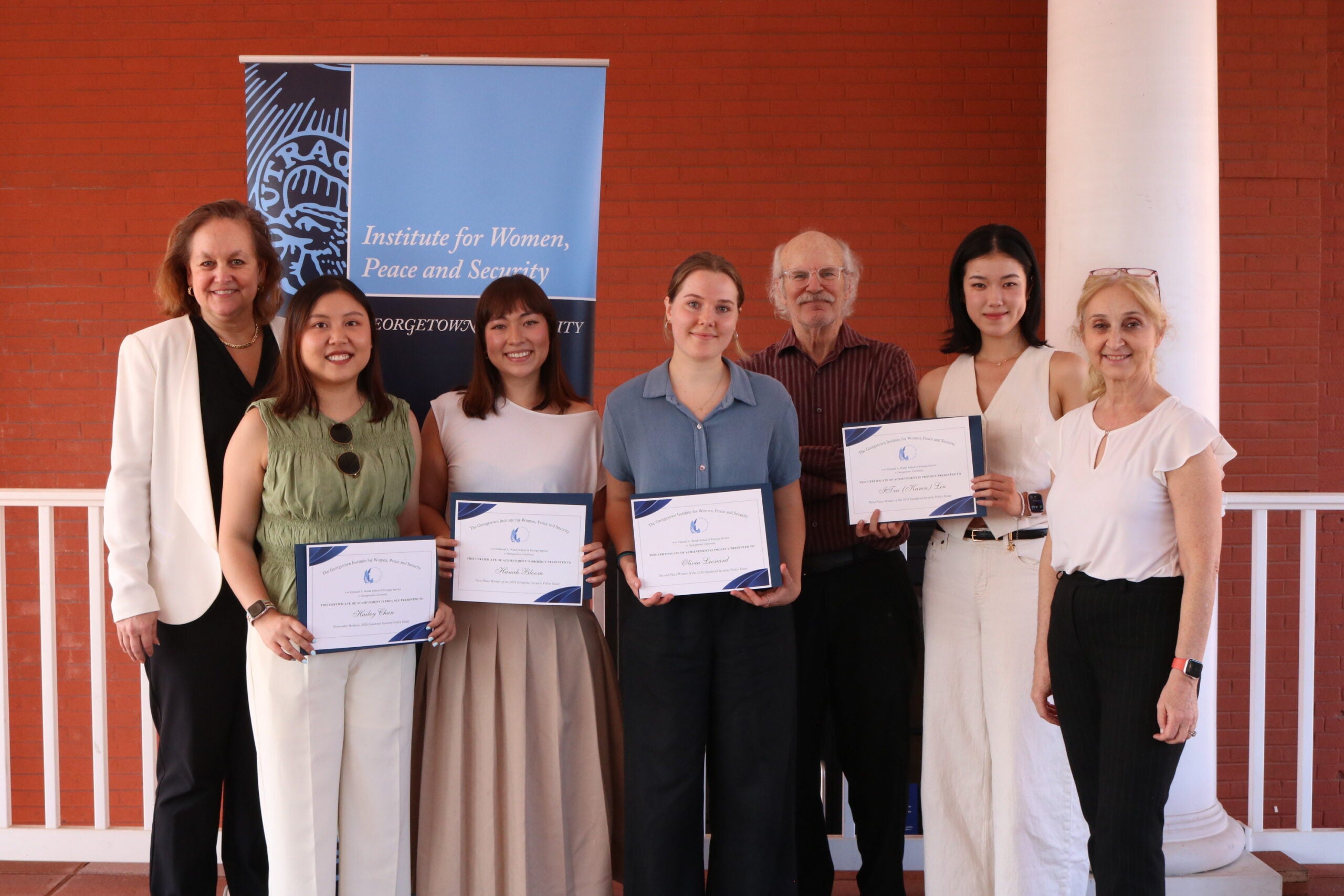
Filling the Vacuum: Japan’s Opportunity for Women, Peace, and Cybersecurity by Hanah Bloom, Georgetown University
As the U.S. retreats from Women, Peace and Security (WPS) implementation, Japan has emerged as a leading proponent of the agenda, wielding it as a form of democratic soft balancing in the Indo-Pacific. Yet Japan’s WPS framework contains a critical blind spot: cybersecurity. This essay argues that Japan should integrate cyber dimensions into its WPS architecture, transforming a domestic policy gap into strategic leadership for the liberal international order. Drawing on Fulbright field research in Tokyo, including interviews with Ministry of Defense officials, think tank researchers, and diplomatic sources, the analysis reveals a misalignment between Japan’s documented technology-facilitated gender-based violence (TFGBV) crisis and its silence on digital dimensions in international WPS leadership, even as regional partners such as the Philippines move ahead.
“The vacuum left by America’s retreat is Japan’s opportunity, not only on traditional WPS pillars like protection and participation, but on the digital terrain where conflict, governance, and gender increasingly converge.”
The Strategic Use of Conflict-Related Sexual Violence by Russian Troops by Olivia Leonard, George Washington University
This essay advances a framework analyzing how conflict-related sexual violence (CRSV) is utilized as a deliberate, strategic weapon of war by Russian forces in Ukraine rather than as a series of random or opportunistic acts. It argues that this violence is structurally engineered to achieve specific military objectives: terrorizing civilian populations under occupation, destroying local community cohesion, and forging internal solidarity among a highly fractured Russian military relying on conscripts and mercenaries. Grounded in documented data from the United Nations and human rights organizations, the paper exposes distinct gendered patterns of abuse, detailing the widespread gang rape and domestic subjugation of women alongside the pervasive, systematic sexual torture of male detainees within captivity networks.
“The use of conflict-related sexual violence by Russian forces demonstrates how conflict-related sexual violence can be strategically used to weaponize gender norms and coerce, intimidate, and fracture communities.”
When Misogyny Becomes Information Warfare: A Taiwan Policy Agenda for Countering Dark Influencers and Democratic Polarization, by ITzu (Karen) Lin, Georgetown University
This essay argues that Taiwan should treat misogynistic “dark influencer” ecosystems not simply as an online culture issue, but as a democratic resilience and information governance challenge. The piece examines how algorithmic recommendation systems can amplify grievance-based, anti-feminist, and exclusionary content, making such narratives appear familiar, entertaining, and socially acceptable. Drawing on research on online misogyny, platform amplification, and Taiwan’s disinformation environment, the author proposes a policy agenda that connects platform accountability, gender equality, and democratic protection.
“The problem is not simply that harmful people exist online. The problem is that platform systems can organize, reward, and normalize their influence.”
Explore More

Sudanese Women Share How to Prevent Mass Atrocities and Promote Peace
Last week, the Georgetown Institute for Women, Peace and Security (GIWPS) hosted…
5 Takeaways from UNGA 81
The Georgetown Institute for Women, Peace and Security (GIWPS) recently returned from…
How the United Nations Can Address Growing AI Concerns to Peace and…
As world leaders convene in New York this week for the UN…