5 Takeaways from UNGA 81

The Georgetown Institute for Women, Peace and Security (GIWPS) recently returned from the 81st session of the United Nations General Assembly. Here are our takeaways.
- A majority of leaders defended the multilateral system while insisting that its institutions be reformed to deliver. Finnish President Alexander Stubb offered one of the strongest defenses during the general debate, acknowledging that multilateralism can be deeply challenging, but that it remains “the best option for humanity.” He warned that “a non-cooperative multipolar order” will ultimately turn against great powers and small states alike. Namibian President Netumbo Nandi-Ndaitwah, her country’s first woman president, urged for equitable representation of the member states in UN institutions and brought the gender agenda back to the center of the General Assembly’s deliberations by closing her address with a call for the United Nations to finally elect a woman as Secretary-General.
- The race to succeed Secretary-General António Guterres formed an unmistakable backdrop to the high-level week. On September 29, days after the general debate, the Security Council held its fourth straw poll, with no clear consensus candidate yet emerging. Many member states remain attentive to the unwritten principle of the regional rotation, which points to Latin America this cycle, and separately the pressure is mounting for the UN to be led by the woman for the first time in its eighty year history. Following Michelle Bachelet’s withdrawal last week, four exceptionally qualified women remain in the race. We are proud to highlight two leaders who have been part of our GIWPS network.
- María Fernanda Espinosa (Ecuador), former President of the 73rd General Assembly and former Foreign and Defense Minister, has built her candidacy around crisis prevention, rebuilding credibility of the UN, and reforming the UN to deliver for all. As she writes in her vision statement, “UN80 will only succeed if it is understood as modernization for results, not austerity disguised as reform.”
- Rebeca Grynspan (Costa Rica), Former Secretary-General of UN Trade and Development and former Vice President of Costa Rica, has pledged to build on UN80 reform, while pursuing deeper structural reform, including of the Security Council. In her vision statement, she affirms that “If elected Secretary-General, my task will be to chart a path of renewal.”
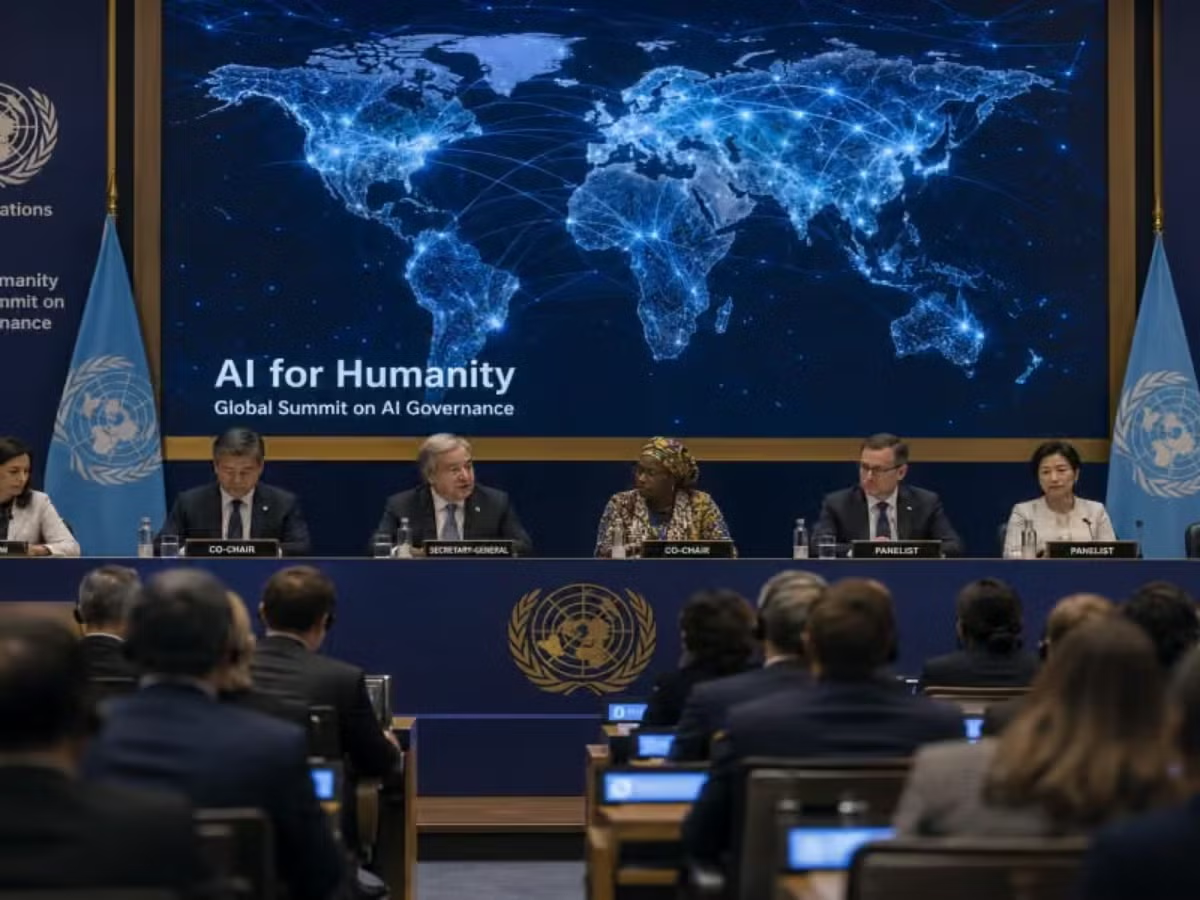
- There was a growing cross-sector call for Artificial Intelligence (AI) governance. During a briefing to the UN Security Council, frontier AI leaders warned that the risks of misuse and loss of control are too great for the private sector to manage alone and urged governments to establish shared standards for testing, verification, and incident disclosure. While most member states called for a common framework for frontier AI and for narrow, enforceable red lines–such as banning AI-enabled biological weapons and keeping humans in control of lethal autonomous weapons–the United States opposed any move toward global governance. Inclusion and participation in AI were recurring themes, with experts pointing to gaps in both geography and gender. With 90% of the world holding less than 1% of global computing power, much of the Global South risks being shaped by AI rather than shaping it. Women face a similar gap, making up only 22% of the AI workforce and less than 14% of senior level leadership. As Liberia’s representative told the Security Council, Africa and the Global South must be “equal co-architects” of AI rather than end-users. The same principle must also apply to women, who should help write the rules for AI in peace and security.
- Conversations during Climate Week NYC, which coincided with UNGA this year, underscored how women and girls are uniquely impacted by consequences of the warming planet, and are uniquely positioned to develop solutions. The case couldn’t be clearer in a country like Afghanistan, where experts noted that climate change is intersecting with gender inequality and conflict in a triple nexus that has devastating impacts; the country is rated among the worst across GIWPS’s WPS Index, the Global Peace Index, and the Climate Vulnerability Index. The international community must understand the unique challenges that climate change poses for women and ensure women have a seat at the table when designing climate solutions and leading implementation initiatives; connect more women to climate finance; and continue the fight to end systematic discrimination against women, which undermines a country’s climate resilience.
- Resilience was an undercurrent throughout UNGA conversations. It was the theme of the Summit of the First Ladies and Gentlemen, convened by Ukraine’s Olena Zelenskaa, who spoke about the incredible strength of the Ukrainian people who continue to defend their homeland. As the First Lady of Belize noted: “Resilience is more than survival; it is holding onto what makes us human while adapting to what changes around us.” Resilience was and continues to be demonstrated by women leaders across civil society, local and national government, business, tech, and research who continue showing up to build a better world.
Explore More
How the United Nations Can Address Growing AI Concerns to Peace and…
As world leaders convene in New York this week for the UN…
A World in Transition: Helen Clark on the State of the World
This week, the Georgetown Institute for Women, Peace and Security welcomed the…

Women, Peace and Security Conflict Tracker: September Updates
Our Women, Peace and Security Conflict Tracker combines real-time data points and…