The Changing Landscape of Peace Mediation: Expert Analysis of The Rise of Middle Powers and the Inclusion Imperative

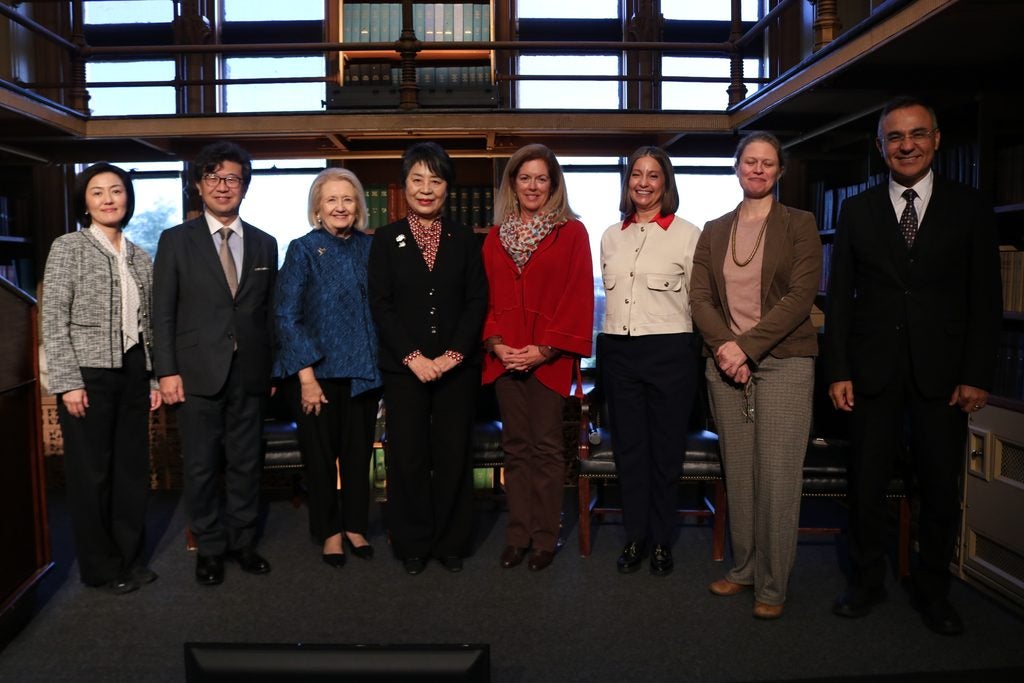
In partnership with the Sasakawa Peace Foundation’s Mediation Support Center, the Georgetown Institute for Women, Peace and Security hosted a high-level event focused on the changing context for international conflict mediation on September 25 at Georgetown University, which was simultaneously livestreamed. As GIWPS Executive Director Ambassador Melanne Verveer noted while opening the symposium: in these times of increased fragmentation and great power competition, middle powers have a vital role to play in peace mediation. Today, as the United Nations (UN) mediates fewer conflicts, national governments are increasingly leading peace mediation efforts, and they are playing a critical role in determining how the processes take place, who participates, and what the outcome is. Amidst this shift, women’s participation and leadership remains essential to both reaching peace agreements and ensuring agreements are more sustainable. The conference featured government officials and experts in peace mediation who are supporting dialogue between parties in conflict. The participants discussed how agreements can be strengthened; how they relate to the core peace and security mission of the United Nations; as well as the importance of inclusion and human rights to undergird agreements, particularly the UN’s Women, Peace and Security (WPS) framework.
The event opened with remarks from Yōko Kamikawa, former Foreign Minister of Japan, who emphasized that the diversification of actors in mediation brings new opportunities to the international community. But as new approaches to mediation are emerging, she underscored that the Women, Peace and Security Agenda must be central, as women are key agents of peace who connect people, build trust, and foster dialogue. Minister Kamikawa also described Japan’s efforts to advance mediation, including the Peace Mediation Unit of the Ministry of Foreign Affairs and Sasakawa Peace Foundation’s Center for Mediation Support, both of which support inclusive mediation around the world. She ended her remarks by noting, “At the heart of these processes must be diverse voices, including women.”
Ambassador Wendy Sherman, former United States Deputy Secretary of State, shared her insights in conversation with Dean Joel Hellman of Georgetown’s School of Foreign Service. Ambassador Sherman is known as “the diplomat for hard conversations in hard places.” She underscored the complexity of mediation processes, drawing on her experience in developing the JCPOA (the so-called “Iran nuclear deal”). There are no shortcuts” said Sherman: mediation takes courage, persistence, and the “use of power for good.” Ms. Sherman noted that as the world order changes, the role of the UN is shifting and middle power countries are stepping up, which she sees as a positive development given their regional influence, ability to understand history and culture, and culturally relevant negotiation style. She noted that global powers should see these governments as key partners in mediation and understand their unique value, stating “we can work together with respect because peace is what’s most important.” Finally, she discussed the ways that artificial intelligence (AI) will change negotiations, emphasizing the need to avoid a new digital divide while also ensuring that humans remain in control of peace processes and that AI is used safely.
These opening insights were followed by a panel of experts moderated by Dr. Akiko Horiba, who is the director of the Sasakawa Peace Foundation Mediation Support Center. Dr. Horiba has been significantly engaged in peacebuilding in Southeast Asia, particularly in Indonesia, Malaysia and Thailand. The panel discussed the ways that middle power countries see and engage in mediation of conflicts, leveraging insights about countries including Egypt, Turkey, Qatar, and more. Dr. Murat Aslan, a Turkish scholar with SETA, the Foundation for Political, Economic, and Social Research, underscored the complexity of today’s conflicts, which include conventional threats, unconventional threats, irregular and regular conflict, hybrid and proxy conflicts, and non-state armed groups. He noted that amidst this complexity, middle powers have a unique role to play, as they can engage a diversity of actors and parties to a conflict. Suzanne DiMaggio, a senior fellow at the Carnegie Endowment for International Peace, shared her experiences on negotiations between the US and Iran, emphasizing the critical role that middle powers played in the JCPOA negotiations because of the lack of formal diplomatic relations between the US and Iran. She also underscored the importance of multi-track diplomacy. Dr. Abdulla Al-Etaibi, a professor at Qatar University, examined Qatar’s role in mediation, emphasizing that successful mediators need both access and trust in order to be successful. He noted that “Qatar can’t afford to stay out” of mediation – it needs to engage because conflicts affect Qatar and the world. He shared that demand is high for Qatar to mediate: the nation receives 30-40 requests for mediation per year. Qatar’s commitment to mediation is built into the country’s constitution and, because it is not generally seen as a security threat, it is able to work with a range of parties. Finally, Dr. Amr Hamzawy, a former Egyptian Parliamentarian and current director of the Carnegie Endowment for International Peace Middle East Program, noted that there are many middle powers in the MENA region, a high level of conflicts in the region over the span of many decades, and a less formal regional order and collective diplomacy than other regions, all of which factor into why governments in the region are leading in mediation directly. He described Turkey and Egypt’s approaches to mediation, from “intelligence diplomacy” to engagement based on proximity to conflict. The panel concluded with the insight from Dr. Akiko Horiba that “no single country can build peace alone” and that the fundamental question is how countries can work together to build peace.
A second panel, moderated by Ambassador Melanne Verveer, examined the question of inclusion, emphasizing that the inclusion and empowerment of women in mediation processes is not just a good diplomatic practice but a strategic imperative to building lasting peace. Dr. Katherine Collin, a Georgetown professor in the Conflict Resolution Program, explained that over the last 10 years, conflicts have become more common and more violent, and they also end less frequently. She argued that inclusion is essential because it tends to create more durable peace agreements and can shift the social dynamics that enabled conflict. She cautioned that state-to-state mediation tends to produce more narrow outcomes instead of comprehensive settlements that address more of these social dynamics and make inclusion more challenging. Stephanie Turco-Williams, former special adviser on Libya to the UN Secretary General and Fellow for Middle East Policy at Brookings Center for Middle East Policy, described her experience mediating conflict in Libya and the ways that diverse women participants from various sectors and backgrounds came together as a unified force during peace talks to develop joint proposals and overcome resistance, despite their differences. But she noted that they participated in the peace talks in an atmosphere of profound intimidation, with attacks and murder of prominent Libyan women advocates and no accountability, which put pressure on women to leave the talks completely. She also described the challenge of systematic disinformation campaigns, and the countermeasure of “radical transparency” by the mediation team to dispel rumors. Next, Ambassador Maria Alonso Giganto of Spain, who is recognized globally for her leadership on women’s participation in peace efforts, highlighted the need to include diverse and intersectional perspectives. She argued that security is not born from force, but rather from social progress, and inclusion is essential. She also emphasized that human rights, and women’s rights, are not up for negotiation during peace talks. They must be off the table completely; all parties must respect these rights.
The summit closed with remarks from Dr. Atsushi Sunami, president of the Sasakawa Peace Foundation, about the work of the Foundation’s Mediation Support Center. Having arrived at the symposium from conflict resolution discussions during the opening meeting of the UN General Assembly, he reflected on the critical role of peace mediators today.
The conference made two things clear: there is enthusiasm about the ways that middle power actors can advance mediation by leveraging new relationships, insights, and tactics to advance peace; and second, that inclusion is essential to any mediation effort.
Explore More

Sudanese Women Share How to Prevent Mass Atrocities and Promote Peace
Last week, the Georgetown Institute for Women, Peace and Security (GIWPS) hosted…
5 Takeaways from UNGA 81
The Georgetown Institute for Women, Peace and Security (GIWPS) recently returned from…
How the United Nations Can Address Growing AI Concerns to Peace and…
As world leaders convene in New York this week for the UN…