A Call for Collective Action: A Conversation with H. E. María Fernanda Espinosa

On November 21, GIWPS hosted a conversation with former President of the United Nations General Assembly, H.E. María Fernanda Espinosa. The discussion, moderated by executive director of GIWPS, Ambassador Melanne Verveer, centered around the future of multilateralism: how the UN can meet today’s complex and dire challenges and the existential threat it faces as an organization. The session offered students the chance to hear Ambassador Espinosa’s reflections on leadership, global cooperation, and the future of women’s roles in peace and security.
Walking into the Philodemic Society Room on Georgetown’s campus is like stepping into a hall of fame, with plaques and photos hanging on the walls to honor alumni of global influence and esteem—the people who embody the debate society’s motto of “Eloquence in Defense of Liberty.” This space was a fitting location for GIWPS to host the conversation “The Future of Multilateralism” with H.E. María Fernanda Espinosa. Ambassador Espinosa is a distinguished Ecuadorian diplomat who served her country as both minister of defense and foreign affairs, and was one of only five female Presidents of the UN General Assembly.
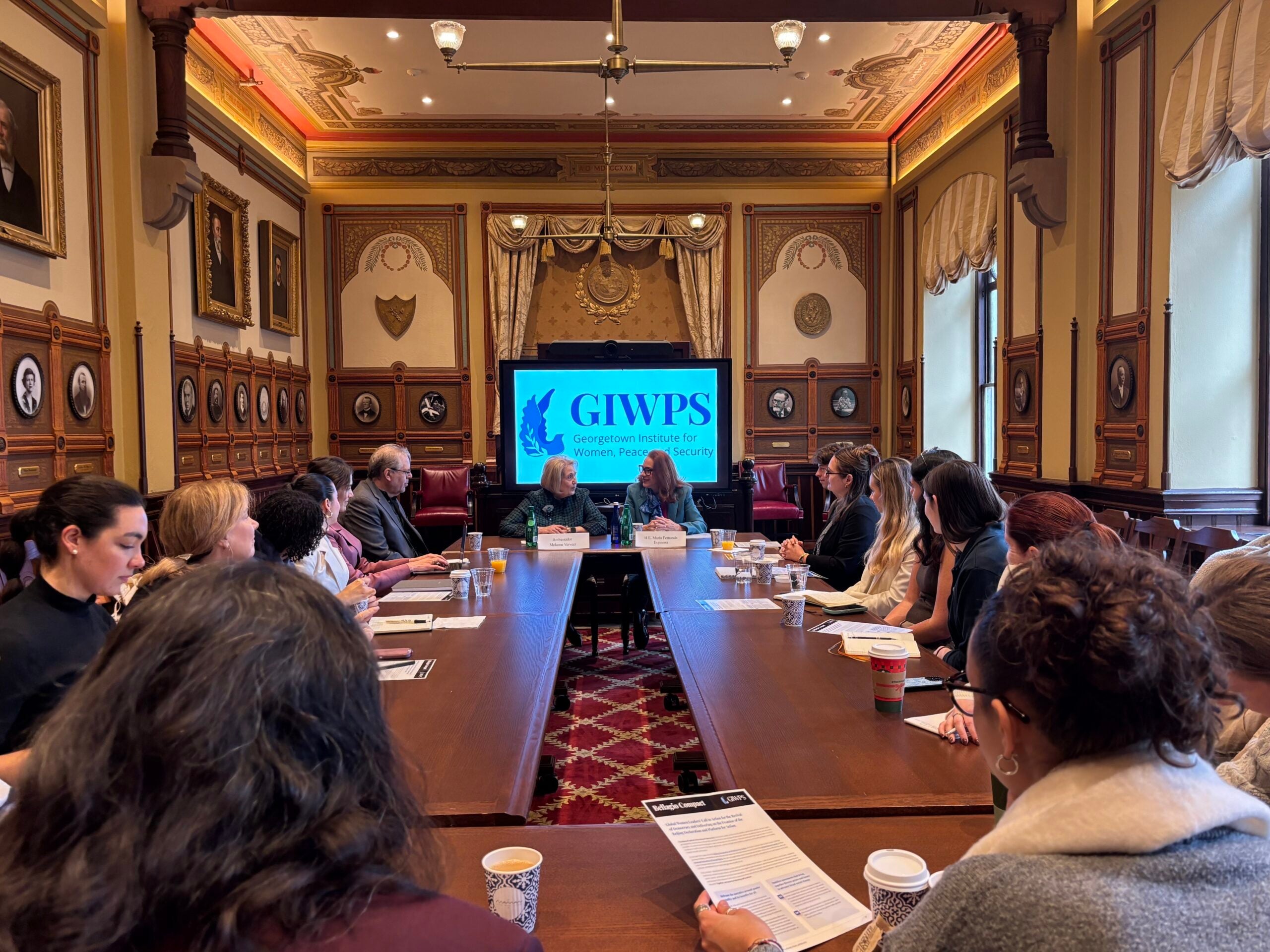
Attending this event was one of the most impactful experiences I’ve had as a graduate student. Georgetown students are always searching for opportunities to hear from people whose leadership genuinely shapes our collective future — people whose words resonate long after the event ends. Ambassador Espinosa is absolutely one of those people.
The Value of Collective Action
The discussion began with the concept of “minga,” a Quechua word that means collective work or action. H.E. Espinosa referred to this concept as an inspiration for her approach to leadership, both as a principle and a practice. As students who are often thinking about the world we will inhabit post-graduation, her insistence on this kind of shared responsibility felt refreshing in a moment when so many political actors are turning inward. It was a reminder that building a better global society requires all of us, and that cooperation is essential. She also emphasized the necessity to center humanity within politics and to embrace complexities that arise in the work. High-level government officials can often exclude or dismiss vulnerability and compassion, but Ambassador Espinosa encouraged us all as future leaders to find what motivates us about service, and to lead with those values at the forefront.
The Future of the UN
Values-based leadership in service of all people was the founding principal in the creation of the United Nations, and Ambassador Espinosa’s shared passion for this mission showed in her reflections on the future of the organization. While other politicians and stakeholders are talking about funding crises at the UN, she instead framed the current moment as a “political and legitimacy crisis.” In her opinion, the UN must be accessible and understandable to regular citizens. She recognized that youth, especially, are underutilized in the current system. Their ideas and energy have the potential to promote change and push for better global cooperation and solidarity, two concepts that are the very definition of multilateralism. To her, modernization at the UN is not optional.
This is a moment to innovate rather than withdraw—to call people in, rather than leave them out. She challenged us to think about how the UN can adapt to new global threats and forms of warfare, like transnational organized crime, and how it can better serve regular people who often feel disconnected from its work. What is the value proposition of the UN? Can it be the epicenter for cross-regional cooperation? She identified that the original preventative diplomacy role of the UN is more relevant than ever, and that the organization is still well-positioned to prevent future conflicts rather than respond once they occur. As she put it, “peace itself is a collective good.” Her reflections made the UN feel less like a distant machine, and more like a project that all of us have a stake in rebuilding.
The Necessity of Women’s Inclusion in Climate Justice
Another thread that resonated deeply was her focus on women as holders of power. She emphasized that sustainable peace is simply not possible without women meaningfully involved at every level. With COP30 in Brazil unfolding in the background, she reminded us that climate impacts are gendered, and that women must be in the room when decisions are made. She praised Brazil’s leadership in shaping a more inclusive climate agenda, from convening local leaders’ summits with mayors to appointing a special envoy focused specifically on women’s issues. At the same time, she cautioned that progress is never guaranteed. She warned that the Mutirão cover decision on how to urgently respond to climate challenges, which referenced gender equality measures from the Paris Agreement and was intertwined with a new Gender Action Plan (GAP), was at very real risk of being rejected or watered down. (The organization that she leads as Executive Director recently posted an update from COP30 with key outcomes).
Creativity in Politics
The conversation also revealed something about Ambassador Espinosa as a person, outside of her diplomatic and professional accomplishments. One of my favorite moments came when Ambassador Espinosa, who is also a poet, spoke about the power and value of language and creativity in political life. ”If we had more poetry in politics, we would be much better off,” she said. In an era defined by rapid technological change and the advancement of artificial intelligence, she sees reading as a form of resistance and freedom to explore the wider world. Empathy, imagination, and deep listening are tools she highlighted as methods to become better leaders and promote true cross-cultural understanding. It was a reminder that how we use our words matters, and that maintaining and centering human dignity and connection is key to bridging divides and resisting the lure of fast-paced, often unnuanced stories that social media and tech platforms popularize.
Find Your Purpose
When students asked how to move forward in the face of gender backlash, Ambassador Espinosa urged us not to tolerate a rollback in rights or participation—and to keep pushing for a more equitable future for the next generation of women and girls. She closed with what felt like a personal appeal to everyone in the room: live in accordance with your values, lead with love, and don’t wait to step into leadership when opportunity arises. “Find your fire.” Ask yourself: what impact, large or small, can I have today? How can I use the opportunities I have to make the world a bit better, each and every day?
My key takeaway was simple but profound: we matter—as individuals and as a collective. If we want our institutions to remain relevant and effective, we must be bold, innovative, and human-centric in imagining their future. Ambassador Espinosa’s words served as a powerful reminder that even in work that sometimes feels abstract or bureaucratic, grounding ourselves in dignity, compassion, and community can transform how we show up and what we’re able to accomplish.
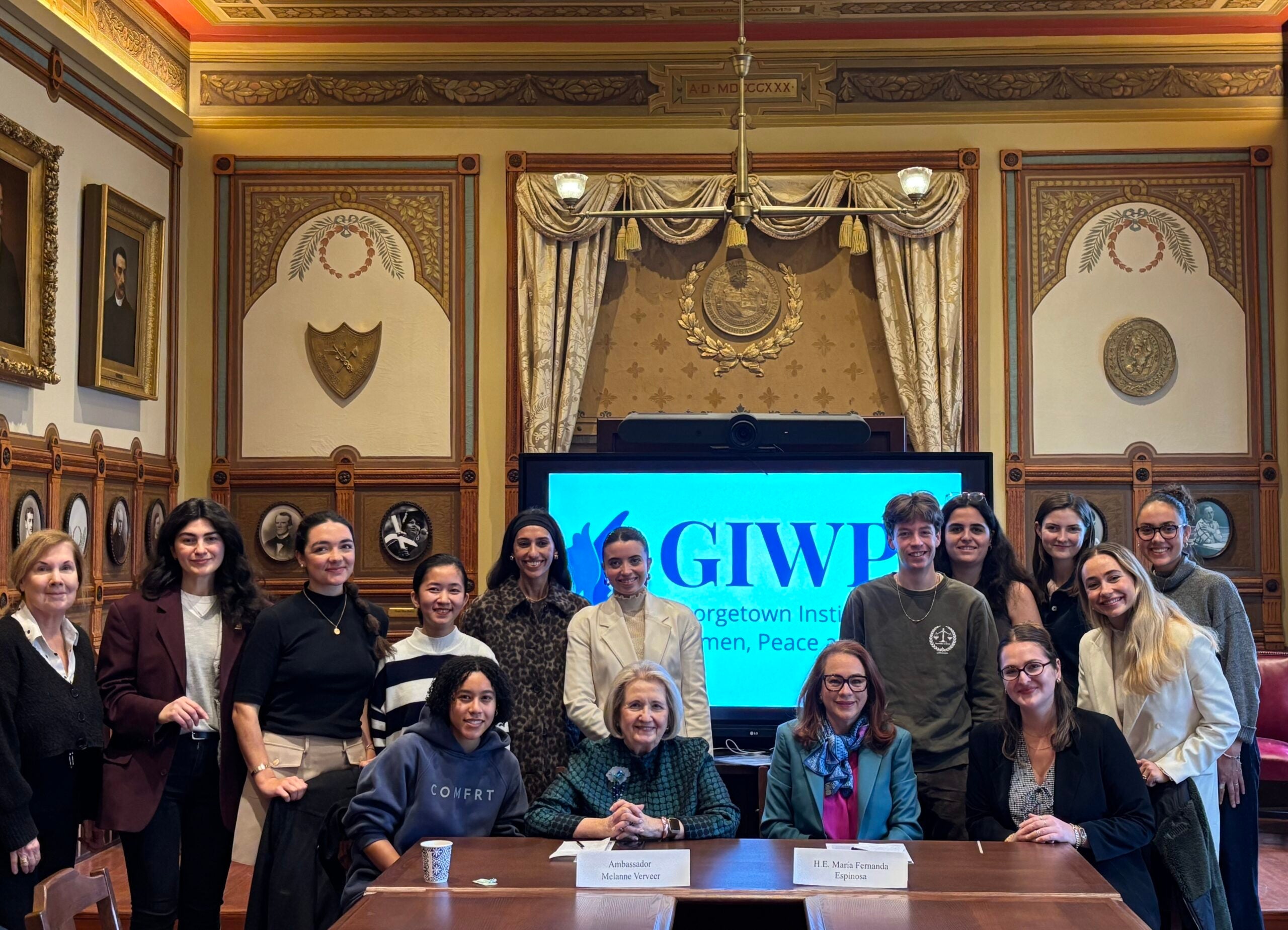
Delani Pecchioli is a Georgetown graduate student pursuing a M.A. in Conflict Resolution and a Certificate in Gender, Peace, and Security from GIWPS.
Explore More
Urgent Appeal for the Release of Nagwa Musa Konda, Sudanese Peacebuilder
The Georgetown Institute for Women, Peace and Security calls for the immediate…

Back ICC as Essential Court for Grave Crime Victims