Recommendations for Strengthening Water Security, Peace, and Gender Inclusion Ahead of the 2026 UN Water Conference

Background
This policy paper summarizes key insights and recommendations for strengthening water security through a Women, Peace and Security (WPS) lens ahead of the 2026 UN Water Conference. It draws on a recent high-level event co-hosted by the Georgetown Institute for Women, Peace and Security, in partnership with the Ministry for Foreign Affairs of Finland, the Women in Water Diplomacy Network, the African Ministers’ Council on Water, and the GlobeCare Foundation on May 12, 2026.
Key Findings
The discussion underscored that water security is a peace and security issue with significant gender dimensions. Water scarcity, droughts, weak governance, and transboundary disputes are directly linked to instability, migration, conflict risk, limited community climate resilience, and heightened vulnerabilities for women and girls. Water governance was framed as central to diplomacy, regional cooperation, and long-term peacebuilding to address these risks.
Women are disproportionately affected by water insecurity but are also leading resilience efforts. Across Africa, the Gulf, and Afghanistan, panelists highlighted how women and girls face heightened risks from water insecurity, including violence, lost education, and economic hardship. However, women are also already taking action to address these risks, including leading community mediation, drought response, WASH governance, climate adaptation, and local peacebuilding efforts.
Inclusion must move beyond representation to real influence and decision-making power. A major theme throughout the event was that participation alone is not enough; women and youth must have meaningful roles in national water policies, transboundary agreements, conference processes, and governance institutions, supported by dedicated funding, leadership pathways, and gender-responsive governance structures.
Financing for water security requires new approaches. Panelists called for blended finance, public-private partnerships, climate finance integration, and other innovative investment approaches that would mobilize capital at scale, de-risk investments, and expand sustainable and conflict- sensitive water infrastructure and services. There is a need to better communicate the economic, resilience, and job creation benefits of water investments, framing them not only as humanitarian spending but also as investments in development, infrastructure, and long-term stability.
The 2026 UN Water Conference must focus on implementation, partnerships, and measurable outcomes. The third-ever UN Water Conference is a key opportunity to advance this agenda. It should move beyond dialogue and deliver concrete action through financing, innovation, partnerships, and scalable solutions.
Effective water diplomacy requires cross-sector collaboration, long-term investment, and stronger multilateral cooperation. Water challenges must be addressed in the context of climate, food security, energy, economic development, and peacebuilding. With weakening multilateral systems and insufficient financing, the international community must shift towards blended finance models, stronger institutional cooperation, and sustained investment in inclusive water governance.
Recommendations for the 2026 UN Water Conference
- Governments and institutions must integrate gender equality and WPS principles across water governance frameworks, including national water policies, transboundary basin agreements, conflict prevention mechanisms, and broader water cooperation processes. Inclusion should not be treated as a symbolic add-on, but rather it should be embedded throughout both decision-making structures and the substance of water policy and governance.
- Women and youth must have meaningful decision-making power in water governance and diplomacy, including through gender-balanced governance structures, formal seats at negotiation tables, and dedicated women and youth advisory mechanisms. Representation should be strengthened across regional and international processes and move beyond symbolic participation toward genuine influence in decision-making.
- Financing and dedicated resources for inclusive water governance must be significantly increased, including through long-term funding commitments, gender-responsive budgeting, blended finance models, public-private partnerships, and stronger investment in women-led water initiatives. Water financing must move beyond traditional sector-specific funding approaches and be more effectively integrated into broader climate and development finance architectures to ensure scale, sustainability, and impact.
- Local and community-based water leadership should be strengthened through support to grassroots women leaders, investing in community-based water management, and creating stronger pathways that connect local actors to national, regional, and international decision-making processes. Elevating local expertise is critical in global water diplomacy discussions, as communities already hold critical knowledge and mediation capacity that should be more systematically recognized and integrated into formal governance and policy spaces.
- The 2026 UN Water Conference should be used as a platform to drive practical implementation and long-term cooperation, with a focus on measurable outcomes, stronger cross-sector partnerships, and expanded stakeholder engagement. Momentum must be sustained beyond the conference itself, including through continued collaboration and follow-up mechanisms. Dedicated platforms for engaging specifically on women, water, peace, and security should be established to ensure these issues are consistently elevated within the conference agenda and related global water governance processes.
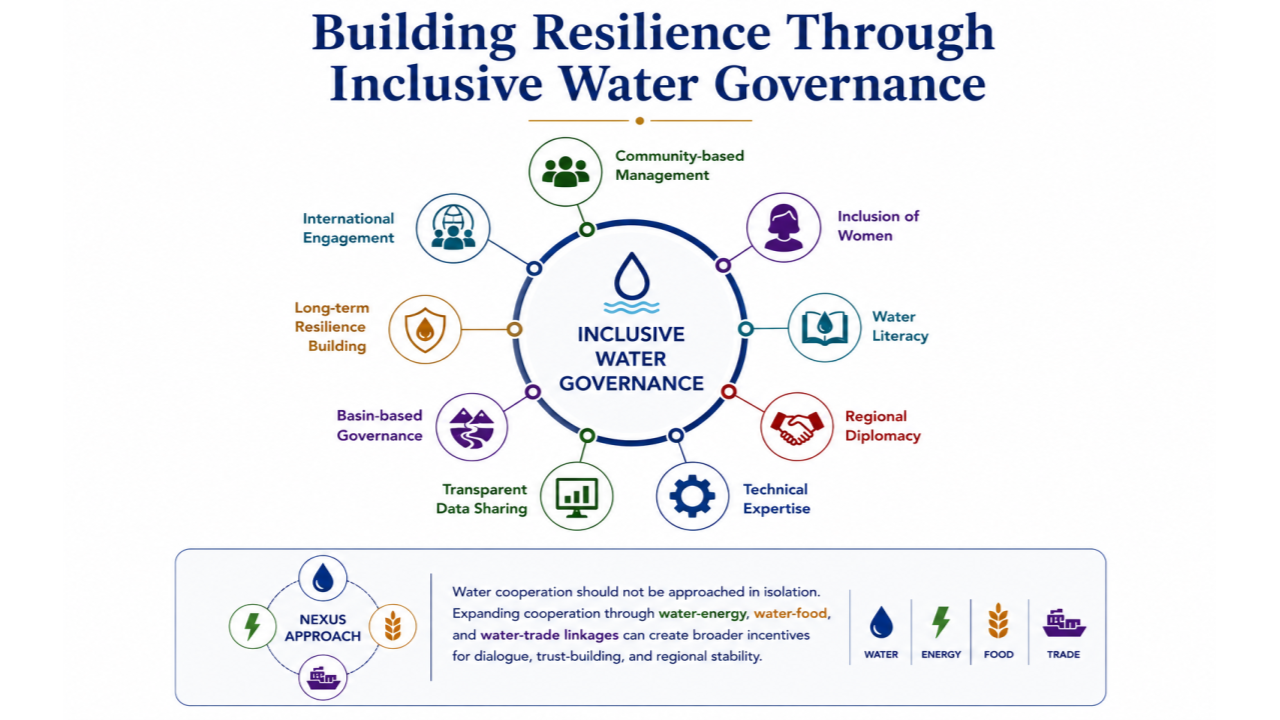
Slide from Foman Forough, Former Director General of the Kabul River Basin
Explore More
Afghan Women Pursuing Peace Under Oppression

The Women, Peace and Security Agenda Beyond 25 Years: Building Institutions for…