Policy Paper: Women’s Leadership as the Missing Link in Climate Action at COP30

Framing: Climate Security Requires Women’s Leadership
From the Sahel to the Pacific, women are mediating conflicts over water and land, leading in climate adaptation efforts, monitoring climate changes, and sounding the alarm; yet their leadership often remains invisible in climate negotiations. The 30th Conference of the Parties (COP30) in Belém, Brazil, presents a pivotal moment to shift from recognizing women’s efforts to ensuring those efforts bring long-lasting results.
COP30 will review and adopt the new Gender Action Plan, building on the Enhanced Lima Work Programme on Gender to address gender gaps and make sure climate policies and programs actively include and support women and other underrepresented groups across all climate governance processes, including adaptation, mitigation, finance, and capacity-building. The GAP presents an opportunity to incorporate mechanisms for women to participate in decision-making and access climate finance, which will better reflect the gender-climate-security nexus. The COP30 Action Agenda explicitly calls for women and historically vulnerable groups to be recognized not just as beneficiaries but as leaders and decision-makers in climate solutions. This moment provides an opportunity to move from token recognition to meaningful action, where women drive the solutions needed to tackle climate change and strengthen peace and resilience.
Climate change is not gender-neutral. Its impacts reflect and deepen existing gender inequalities, and women have a central role to play in advancing climate action. Climate disasters quickly become gender and security crises, where the erosion of livelihoods feeds violence and vulnerability, and where empowering women to lead recovery could mean the difference between instability and resilience. Differences in power, resource access, and social roles mean women are more likely to lose livelihoods, face displacement, or experience violence when climate shocks hit. Climate change could force into poverty 16 million more women and girls than men and boys.
Even in the face of persistent obstacles, across the globe, women are driving some of the most innovative and community-centered climate solutions. In Kenya and Ethiopia, women’s cooperatives are restoring degraded lands and building climate-resilient livelihoods through regenerative agriculture. In the Pacific Islands, women leaders are integrating traditional ecological knowledge into disaster preparedness and adaptation planning. From Brazil’s Amazon, where Indigenous women defend forests from illegal logging, to cities in Europe and Africa, women are shaping more inclusive and sustainable responses to climate crises.
As Parties approach COP30, the global community faces a pivotal choice: continue treating women’s leadership as a secondary “social issue” or strategically embed it as a core pillar of climate security, adaptation, resilience, and the maintenance of peace and social stability. Women’s leadership means meaningful and active participation and influence in climate governance: from shaping priorities, leading negotiations, designing policies, managing resources, and driving solutions in their national and local governance and community structures. This is critical, because when women are excluded, adaptation strategies are less effective, peacebuilding efforts are weaker, and policies risk overlooking the needs and knowledge of the communities most affected by climate change.
Research from the Georgetown Institute for Women, Peace and Security (GIWPS) highlights the critical link that including women not only promotes equity but also strengthens resilience, improves outcomes, and increases the sustainability of climate and peace initiatives. Climate security, adaptation, and peace are interdependent: excluding women can weaken both adaptation and social stability, meaning poor climate responses can exacerbate conflict, while fragile peace reduces resilience. Ensuring women’s leadership is therefore essential for achieving the Paris Agreement goals and ensuring no one is left behind.
At the Georgetown Institute for Women, Peace and Security (GIWPS), we identify five technical priorities that should anchor COP30 commitments and their post-COP implementation. These priorities integrate WPS principles into climate governance, finance, and resilience systems, combining moral, economic, and security imperatives.
This note identifies five technical priorities, aligned with the COP30 Action Agenda Priorities that should guide Parties and institutions at COP30 and beyond:
- Women’s Representation and Negotiation Capacity at COP
- Gender-Responsive Climate Finance Architecture
- Women’s Climate Adaptation, Livelihoods, and Productive Systems
- Women’s Urban Resilience and Early Warning
- Gender Dimensions of the Water–Energy Nexus
Each priority is supported by empirical evidence, identifies specific mechanisms for implementation, and outlines actionable recommendations.
1. Women’s Representation and Negotiation Capacity at COP
Today, representation of women at climate conferences and in national delegations remains highly uneven. Data from 2024 show that women made up 31 percent of party delegations at COP28, the same proportion as a decade earlier in 2013. This stagnation is a major problem because it shows that, despite growing awareness, women’s voices remain systematically underrepresented at the highest levels of climate negotiations, limiting the effectiveness, equity, and legitimacy of global climate action.
At COP29, women made up just 35 percent of party delegations and 33 percent of deputies and delegation leaders. While these numbers align with broader trends in women’s political representation globally, the critical issue is not just the total share of women but the diversity of women represented. Indigenous women, women from ethnic minorities, and women with visible and non-visible disabilities remain severely underrepresented. Many delegations face practical barriers to achieving this diversity: the high costs of sending delegates, visa and travel restrictions, lack of institutional support for gender advisors, and structural inequalities that limit who can participate in international negotiations. These constraints often exclude grassroots leaders and women from small and fragile states, particularly Small Island Developing States (SIDS), from attending COP (and pre-COP) sessions and elevating gender priorities during negotiations. Moreover, there is a persistent lack of lead female negotiators, which further diminishes women’s influence in shaping global climate agreements.
Consensus-driven COP processes require all Parties to agree before decisions are adopted. This often slows negotiations, prioritizes compromise over ambition, and sidelines issues perceived as politically sensitive, including women’s issues and broader social integration. As a result, commitments to women’s leadership, participation, and targeted financing are delayed, limiting their impact on climate adaptation and resilience.
Evidence shows that meaningful participation of women improves outcomes across climate governance and adaptation planning: resources are managed more sustainably, local innovations scale more effectively, and peace agreements and resilience programs endure longer. Empowering women negotiators ensures adaptation strategies reflect lived realities, strengthens peacebuilding outcomes, and supports locally led climate solutions. Women’s representation and active leadership in peace, security, and climate action is not just a theoretical principle. It is a practical, yet underutilized, global tool for advancing justice, security, and enhancing climate resilience. Recognizing women’s participation, protection, and leadership is a critical condition for lasting peace, effective climate governance, and sustainable resilience.
COP30 Recommendations for National Governments/States, UNFCCC Secretariat, COP Bureau, SBI/SBSTA, and Climate Finance Boards:
Strengthen women’s negotiation power and leadership across delegations, ministries, and climate institutions. Parties, the UNFCCC Secretariat, and the COP Bureau should institutionalize gender expertise requirements, ensure Gender Action Plan resources are fully accessible, and remove barriers that limit participation, such as funding, travel, and logistical constraints, particularly for Small Island Developing States (SIDS), and Indigenous, grassroots, and other underrepresented women. Supporting diverse and lead female negotiators will ensure gender-responsive positions, elevate marginalized perspectives, and improve the effectiveness, equity, and sustainability of climate decisions.
Implementation Mechanism:
- Mandate all national COP delegations, climate ministries, councils, and adaptation fund boards to include qualified gender experts and ensure balanced representation of women of at least 40 percent, including Indigenous, grassroots, and underrepresented groups, in lead or decision-making roles.
- Establish a legally recognized funding window within existing climate funds to provide dedicated, predictable, multi-year financing for the Gender Action Plan on Climate Change, ensuring resources reach national and local implementation and women’s local organizations, including support for Indigenous, grassroots, and underrepresented women.
- Mandate the UNFCCC Secretariat and COP Bureau to establish a pre-COP gender capacity and coordination mechanism for SIDS and smaller delegations at least six months before COP, providing dedicated funding, mentorship, and technical support, such as negotiation workshops and simulation exercises for women and grassroots negotiators, and track their contributions to negotiation outcomes.
- Revise COP decision-making procedures to ensure that consensus rules cannot delay or block gender agenda items, including mechanisms for advance agreement, protected negotiation time for gender issues, and reporting on progress to hold Parties accountable.
- Ensure formal registration, travel support, and a dedicated fund for Indigenous, ethnic minority, and grassroots women delegates, and establish minimum national participation quotas to guarantee their representation in COP negotiations.
2. Gender-Responsive Climate Finance Architecture
The World Bank estimates that strong adaptation measures can deliver up to four times their cost in economic returns. Adaptation finance should be viewed not merely as aid but as a high-return investment. Yet women on the frontlines of climate adaptation receive insufficient financial support, limiting the effectiveness of adaptation and resilience programs. In 2022, only 3 percent of $28.2 USD billion in adaptation funding targeted gender equality objectives, and just 0.01 percent of global climate finance addressed both climate and women’s empowerment simultaneously. This gap is alarming because it means the very groups driving community-level adaptation–the women implementing early warning systems, managing water resources, and sustaining local food systems–are systematically excluded from the funding meant to support their work. Promoting women’s leadership and equitable participation in climate finance decisions, while closing persistent gender gaps in access and influence, is critical to achieving fair and resilient climate action.
Improving women’s leadership in climate adaptation, peace, and security is also smart economics, especially for fragile, conflict-affected, and violent (FCV) states. For example, rural female-headed households in low- and middle-income countries (LMICS), lose, on average, 8 percent more income during heat waves and 3 percent more during floods than male-headed households, representing per capita reductions of $83 due to heat stress and $35 due to floods, totaling roughly $37 USD billion and $16 USD billion respectively, across all LMICs. The World Bank’s Gender Strategy 2024–2030 underscores this link, calling gender integration in climate finance essential to resilience and inclusive development.
Failing to invest in women globally costs an estimated $10 USD trillion annually; supporting female farmers alone could add $1 trillion USD to global GDP. Directing billions of dollars toward women is not a cost. It is one of the highest-return climate investments the world can make. COP29 and COP30 Presidencies will present the “Baku-to-Belem Roadmap” to mobilize 1.3 trillion by 2035. The report focuses heavily on the private sector and multilateral development banks—this is what is at stake at COP30. Directing finance to women can offer climate and social benefits in agriculture and food security; water and energy access; disaster preparedness and adaptation, entrepreneurship and livelihoods, and peace and community cohesion. By channeling finance directly to women and to women’s organizations, Parties can simultaneously strengthen adaptation capacity, reduce poverty, and enhance peace outcomes.
COP30 Recommendations for Multilateral Climate Funds and Development Partners (UNFCCC, GCF/GEF, MDBs, UN Agencies), Bilateral Donors, and the Private Sector:
Multilateral climate funds and development partners should redirect adaptation finance to women-led initiatives and local actors on the frontlines of climate insecurity, ensuring resources are allocated in measurable, accountable ways and prioritizing Indigenous, grassroots, and marginalized women in fragile and conflict-affected contexts.
Implementation Mechanisms:
- Scale up concessional financing by establishing dedicated funding windows that allocate at least 30 percent of adaptation finance to women-led cooperatives, small-to-medium enterprises, and local associations in fragile and conflict-affected (FCV) settings. Require transparent reporting on disbursement, participation, and measurable outcomes, and provide technical support and capacity-building to ensure funds reach intended beneficiaries effectively.
- Scale up the Global Climate Resilience Fund for Women to support and protect women against extreme heat, floods, and coastal erosion. For example, building on insights from the 2022 Bellagio conference and GIWPS’s collaboration with the Rockefeller Foundation and the Self-Employed Women’s Association, an innovative insurance fund developed to support women working in extreme heat, providing pay when temperatures reach unsafe levels (e.g.a micro-insurance scheme for heat exposure).
- Restructure climate finance architectures to channel funding to protect the environment (e.g., free, prior, and informed consent or FPIC, mitigation, disclosure) and social safeguards (e.g., inclusion, protection, redress) for female climate activists, peacebuilders, and human rights defenders; and support bilateral and multilateral mechanisms to provide digital, physical, and psychosocial support to defenders and activists who face acute risks due to their work.
- Establish dedicated funding programs for women-led agricultural initiatives, including community seed banks, regenerative farming practices, and drought-resistant crop programs. Require grantees to track women’s participation, adoption rates, crop yields, and improvements in local food security, and provide technical assistance and training specifically for women farmers to ensure effective implementation and equitable impact.
- Embed performance-based contracts and results-based financing that link disbursements to measurable outcomes in women’s leadership and climate security, require implementing partners to provide training and technical support, release funding in phases tied to milestones, and mandate standardized reporting on progress and impact. For example, financially rewarding governments who provide equitable access to safely managed water supply, improved wastewater, electricity, and sanitation, including menstrual hygiene kits; or incentivizing a quota to have women participate in local disaster risk management committees in leadership positions.
- Require all major climate funds and bonds (green, blue, and other instruments) to include mandatory gender indicators that track women’s leadership, participation, and benefits across infrastructure, nature-based solutions (NbS), water, energy, and local adaptation projects. Implement standardized reporting, integrate these indicators into funding decisions, and tie disbursements to measurable gender-responsive outcomes.
- Traditional climate finance mechanisms should be reformed to explicitly account for care responsibilities, displacement, and informal livelihoods, ensuring post-conflict and post-disaster funding reaches affected women like female-headed households, elderly, women with disabilities, and Indigenous women.
3. Women’s Climate Adaptation, Livelihoods, and Productive Systems
Climate-induced displacement, violence, and early marriage disproportionately affect women and girls in fragile contexts such as South Sudan, with girls often married younger when families struggle to survive in displacement camps. Women and girls are also disproportionately affected by climate-related loss and damage, losing livelihoods, facing displacement, and shouldering increased care responsibilities after extreme climate events.
Although most National Adaptation Plans (NAPs) mention gender, only about 50 percent recognize women as active agents of change, and very few include measurable targets or leadership roles for women in adaptation processes. International Institute for Sustainable Development (IISD) found that while 98% of submitted NAPs mention gender, only about 50 percent recognise women as agents of change in the adaptation planning process. Similarly, according to the United Nations Framework Convention on Climate Change (UNFCCC), only 32 percent of NAPs included gender-responsive means of implementation (funding, budgeting, capacity-building) in their adaptation sections.
Climate adaptation is inseparable from peacebuilding, and both are inseparable from gender equity and economic livelihoods. Rising temperatures threaten women’s economic rights: A 2025 World Bank study finds that a 1-unit increase in temperature anomaly corresponds to a 1.5-point drop in the Women, Business and the Law (WBL) index. The WBL index measures legal gender equality, assessing laws and regulations that affect women’s economic opportunities, such as access to work, property, credit, and entrepreneurship. These legal and economic barriers compound women’s vulnerability in urban and coastal areas. As cities and coastal economies transition to green and circular systems, women in informal and resource-dependent sectors from fisheries to tourism risk further marginalization unless they are explicitly integrated into early warning systems, resilience planning, and climate risk management strategies.
Ignoring the gendered impacts of climate change such as women’s disproportionate exposure to displacement, loss of livelihoods, unpaid care burdens, early marriage, and exclusion from decision-making—risks exacerbating inequality and instability. Evidence shows that gender equality directly strengthens climate resilience: each 1 percent increase in gender equality boosts climate adaptation capacity by 0.39 percent, and 2025 GIWPS research (figure S1.1.1) shows that countries scoring higher on women’s inclusion, justice, and security are more climate resilient. Failing to address the gendered impacts of climate change undermines economic, climate, and peace outcomes, highlighting that directing and channeling funds to women is a moral and strategic imperative. Ensuring that adaptation and loss-and-damage finance and programs explicitly target women’s leadership, participation, and protection is essential to building equitable, effective, and resilient livelihoods and productive systems.

COP30 Recommendations for National Governments and Delegations, Multilateral Climate Funds and Development Partners, Local Women’s Organizations, and Indigenous and Grassroots Actors:
Integrate measures designed to address the specific needs, roles, and leadership of women and underrepresented groups like Indigenous peoples, ethnic minorities, and persons with visible and non-visible disabilities into National Adaptation Plans (NAPs). This should include dedicated budgets, specific targets for women’s participation and leadership, and monitoring mechanisms with gender-disaggregated indicators to track progress by gender identity through the Global Goal on Adaptation indicators.
Implementation Mechanisms:
- Allocate at least 20% of adaptation finance in fragile and conflict-affected states to women-led climate-resilient livelihood projects, with annual reporting on funds disbursed, number of women beneficiaries, and measurable improvements in food security, income, and local resource management.
- Require National Adaptation Plans (NAPs) and Just Transition strategies to include targets for women’s leadership and participation, such as having women lead committees or decision-making roles in renewable energy, agriculture, and climate resilience initiatives, supported by technical assistance and mentorship programs.
- Provide women’s dedicated access to productive assets, including housing, land, and property (HLP) rights, credit, technology, and skills in renewable energy, regenerative agriculture, and climate-smart value chains, through dedicated funding windows, legal safeguards, and training programs.
- Embed livelihood protection measures into peacebuilding, humanitarian, and loss-and-damage programs, such as cash-for-work schemes, insurance, and social safety nets, ensuring women are actively involved in program design, implementation, and monitoring, with clear reporting on participation and outcomes.
4. Women’s Urban Resilience and Early Warning
In fragile and conflict-affected settings, climate change becomes a matter of life and death for women and girls, who are often hit hardest by climate impacts and shut out of the very decisions shaping their survival. In Myanmar, during the 2024 floods and mud‑slides, more than 1 million people were affected, of which 60 percent were women and girls. Over 360 deaths were reported with women and girls facing heightened risks of violence, health crisis and inadequate shelter. Research published in 2024 estimates that women are 14 times more likely to die in a climate‑disaster (including floods, storms) than men. Existing social inequalities put women at the highest risk during crises. For women in Myanmar, and for millions more around the world, being excluded from climate decisions is not a policy gap; it is life or death.
Women’s networks and traditional indigenous knowledge are essential for effective climate risk management and early warning systems, particularly in urban and coastal areas prone to floods, erosion, cyclones, and heat waves. However, systems are often under-resourced and/or less effective at reaching women due to limited engagement of women in climate risk management and early warning planning, gender-blind infrastructure, cultural barriers, and insufficient use of local women’s networks. Inclusive planning that centers women of all intersectional identities improves the uptake of inclusive adaptation measures, strengthens life-saving responses, and enhances national and community resilience.
Existing loss and damage mechanisms rarely prioritize women’s specific needs or leadership, limiting the effectiveness of recovery efforts, particularly for Indigenous, rural, and low-income women. A submission to the United Nations Framework Convention on Climate Change (UNFCCC) Gender Action Plan review states that “Indigenous women, women with disabilities, rural women, women living in poverty face even higher risks of experiencing discrimination and loss and damage, and calls for loss and damage programs to advance a human‑rights‑based approach. Supporting women’s participation in adaptation and recovery is critical for sustaining productive systems, including agriculture, local resource management, and small-scale enterprises. Ensuring that loss and damage finance and programs explicitly prioritize women’s leadership, participation, and protection is essential to building equitable, effective, and resilient recovery and adaptation systems.
COP30 Recommendation
Require urban resilience projects, early warning systems, and loss-and-damage programs to include women in leadership and technical roles, track gender-disaggregated outcomes, and to ensure that design, implementation, and recovery measures meet the needs of women and girls, including Indigenous, rural, and low-income communities.
Implementation Mechanisms:
- Allocate dedicated loss-and-damage finance for women and women-led organizations in fragile and conflict-affected contexts, ensuring funding supports livelihood recovery, early-warning systems, and care responsibilities. Programs should require women’s participation in design, decision-making, and monitoring, with annual reporting on funds disbursed and measurable outcomes for women’s resilience and leadership.
- Require every national and municipal climate, infrastructure, and disaster-risk plan to include a mandatory gender and environmental assessment, with clearly assigned staff responsible for collecting sex-disaggregated data, conducting vulnerability mapping, and reporting progress annually to the Climate Ministry or municipal authority.
- Mandate that at least 35 percent of decision-making positions in urban and coastal early warning design, heat adaptation strategies, and climate-resilient infrastructure projects are held by women, with a special focus on women from Indigenous, rural, and marginalized communities. Include quotas for leadership roles in project steering or disaster risk management committees and technical advisory boards.
- Implement government- and donor-funded programs to provide hands-on training for women’s organizations in disaster response, nature-based solutions, and digital early warning systems. Tie funding to measurable outcomes, such as the number of trained leaders who actively participate in local climate governance, disaster drills, or community adaptation projects within a 12-month period.
5. Gender Dimensions of the Water–Energy Nexus
Women are often responsible for managing household water and energy, and their participation in governance enhances the reliability, efficiency, and sustainability of these systems while strengthening community resilience to climate shocks. Globally, women constitute only 18 percent of the water and sanitation workforce, illustrating the magnitude of their under‑representation in key infrastructure sectors.
Yet when water and energy infrastructure is unreliable or poorly managed, women disproportionately bear the negative impacts, particularly in coal-dependent communities where mine and thermal power plant closures exacerbate social stress. Rising male unemployment in these areas can lead to increased domestic violence, food insecurity, and reduced social status for women, while limited access to water and energy infrastructure exposes women to gender-based violence and sexual exploitation, increases time poverty, and reduces economic autonomy.
Despite being the primary managers of household resources, women remain largely excluded from technical and governance roles, holding only about 20 percent of jobs in the global energy sector and just 26 percent of leadership roles in water institutions across the Global South. This exclusion limits their ability to shape more resilient, inclusive systems. At the same time, energy transitions offer opportunities to improve women’s lives: technologies such as solar cooking stoves and lanterns can enhance health, reduce time spent on manual tasks like collecting fuelwood, and expand economic and social opportunities.
Just Transition strategies similarly remain largely gender-blind, often excluding women from decision-making and benefit-sharing. A report from UN Women on just transitions highlights that many transition policies remain “gender‑blind,” underscoring the systemic omission of gender considerations in many frameworks. This gap highlights the urgent need to integrate gender-responsive measures into Just Transition frameworks to ensure women’s participation, leadership, and equitable outcomes.
COP30 Recommendations for National Governments, Utilities, and Climate Finance Institutions:
Ensure that every local and national water, energy, and Just Transition plan includes assessments that address key gender gaps in the sector and support women’s leadership and security linked to Nationally Determined Contributions (NDCs) and National Adaptation Plans (NAPs); increase women’s leadership in utilities and user associations with resourced focal offices; expand targeted finance models for women and female-headed households to access renewable energy and water infrastructure; and invest in vocational training and apprenticeships to build women’s technical capacity in system maintenance and resilience.
Implementation Mechanisms:
- Include gender and environmental assessments and targets into local and national water, energy, and Just Transition strategies consistent with national climate plans like Nationally Determined Contributions (NDCs) and National Adaptation Plans (NAPs). Assign specific staff in ministries to collect sex-disaggregated data, conduct vulnerability mapping, and report progress annually.
- Mandate that at least 40% of leadership and technical positions in utilities, user associations, and oversight boards be held by women, including Indigenous, rural, and marginalized women. Establish resourced gender focal offices in ministries to oversee recruitment, track participation, and ensure women have decision-making power.
- Develop microfinance, subsidies, and pay-as-you-go (PAYG) schemes specifically for women (e.g., Indigenous women, women from ethnic minorities, and women with visible and non-visible disabilities) to access renewable energy systems (solar, mini-grids, clean cookstoves) and water infrastructure. Prioritize programs in flood- and climate-vulnerable regions, linking finance disbursement to demonstrable adoption rates and usage.
- Launch government and donor-funded programs to train women in renewable energy, water system maintenance, and climate-resilient infrastructure. Link training completion to employment, community adaptation projects, or certification, with annual tracking of participants, placement rates, and local resilience outcomes.
A Call to Action: Center Women for Climate Security at COP30
COP30 is a pivotal opportunity to integrate attention to gender issues as a cross-cutting solution area at the core of global climate governance and security—not as an add-on—but as a structural condition for climate resilience. What matters most, however, is what comes after COP: whether governments, multilaterals, and donors move beyond symbolic inclusion to ensure women are resourced, empowered, and positioned as decision-makers in climate finance, adaptation planning, and governance.
Investing in women is a resilience strategy. When women have access to finance, resources, and decision-making power, they can implement climate-smart agriculture, manage water and energy systems, and lead early warning and recovery efforts, reducing climate vulnerability and improving outcomes for entire communities. A just climate transition depends on women’s full participation and leadership.
The Georgetown Institute for Women, Peace and Security urges negotiators, Parties, and donors to act decisively: to prioritize women’s diverse representation in climate governance, financing, and authority. This will ensure women are not only included but adequately resourced, equipped, and empowered to lead climate action to build a more peaceful, secure, and climate-resilient world in the decades ahead.
Explore More
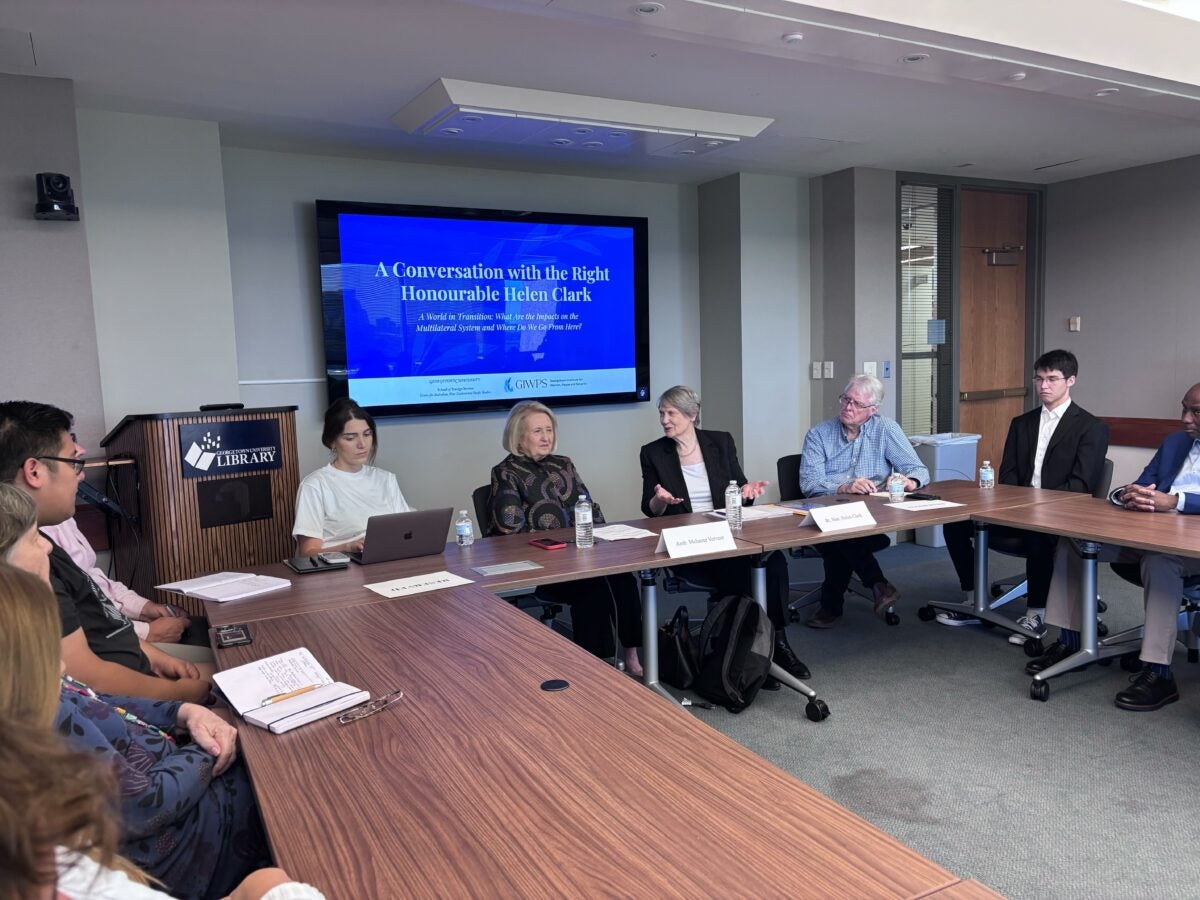
A World in Transition: Helen Clark on the State of the World
This week, the Georgetown Institute for Women, Peace and Security welcomed the…

Women, Peace and Security Conflict Tracker: September Updates
Our Women, Peace and Security Conflict Tracker combines real-time data points and…