The Central African Republic (CAR) has experienced entrenched political instability and armed conflict since 2013, when the predominantly Muslim Séléka coalition seized the capital and overthrew the government. Predominantly Christian anti-balaka militias subsequently mobilized against Séléka forces and attacked Muslim civilians, deepening religious and communal divisions. Although violence has declined from its peak, the conflict has become increasingly fragmented, with armed groups—including ex-Séléka and anti-balaka factions and the Coalition of Patriots for Change (CPC)—continuing to challenge state authority, particularly in the north, east, and southeast. Weak state institutions and limited government presence outside Bangui, competition over land and natural resources, and tensions between pastoralists and farmers contribute to localized violence. Conflict in neighboring Sudan has further exacerbated insecurity and displacement, including through cross-border armed-group activity and refugee inflows.
The 2019 Political Agreement for Peace and Reconciliation and subsequent disarmament efforts have contributed to reductions in violence, but implementation remains uneven and some armed groups continue to operate outside the peace process. Government forces, supported by Russian and Rwandan security personnel, have expanded their presence in some areas, while armed-group activity and attacks on civilians persist elsewhere. The December 2025 presidential and legislative elections and April 2026 second-round legislative, regional, and municipal elections proceeded with relatively limited election-related violence, although insecurity prevented voting in some locations during the December polls. Despite increased returns of displaced populations, renewed insecurity in parts of the southeast and northeast, severe humanitarian funding shortfalls, weak state capacity, and humanitarian and economic challenges continue to complicate sustainable peace and reintegration. As of early-2026, insecurity and restricted humanitarian access in Haut-Mbomou, including around Zémio, had contributed to further displacement and attacks on civilians and humanitarian workers.
Women and girls in CAR continue to face high levels of humanitarian need and difficulty accessing resources, as crisis response is undermined by continued political instability. Conflict-related gender-based violence remains widespread and underreported, while insecurity and displacement continue to disrupt access to sexual and reproductive health services, particularly in areas affected by persistent fighting. Severe humanitarian funding shortfalls are further limiting access to GBV prevention and response, sexual and reproductive health, and other essential services for women and girls. Broader gender inequalities also constrain girls’ access to education and economic opportunities: more than 30 percent of girls enrolled in primary school drop out before completing their studies, while approximately 61 percent of women ages 20–24 were married before reaching 18 years of age.
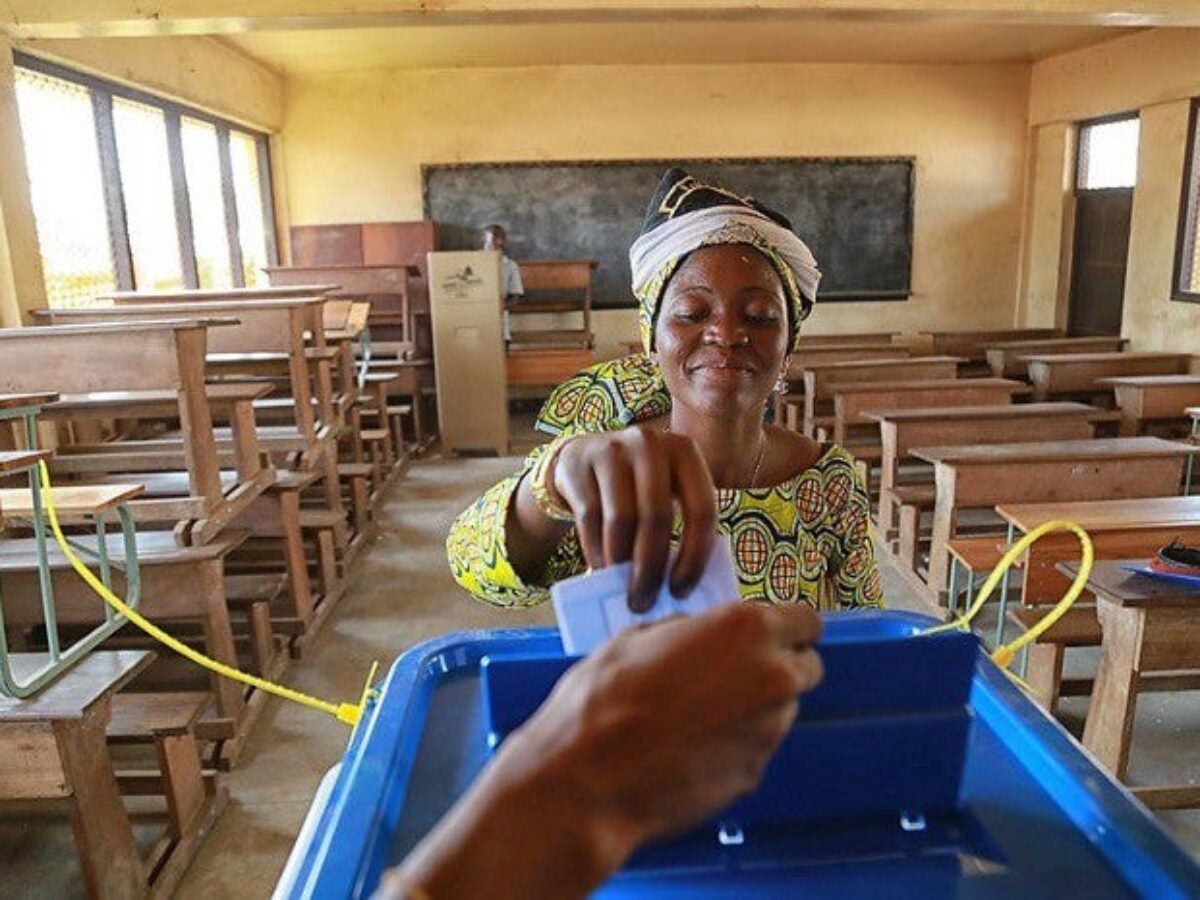
Women’s participation in the 2025–26 electoral cycle was mixed. Women comprised more than 47 percent of voters and nearly half of municipal candidates in the December 2025 elections, and women subsequently secured 45 percent of elected municipal council seats, including the mayoralty of Bangui. By contrast, only eight women were elected to the 144-seat National Assembly, or roughly 6 percent of legislators, despite the country’s 35 percent quota for political party candidates. The disparity between women’s relatively high participation as voters and at the municipal level and their limited representation in national office underscores persistent barriers to women’s political leadership.
Although women and girls in CAR face multifaceted challenges to their safety, livelihoods, and participation, they continue to advance efforts to implement the 2019 peace agreement and played a key role in CAR’s ratification of the Maputo Protocol on August 26, 2025. Women-led organizations also continue to lead community mediation, peacebuilding, and survivor services, including psychosocial support and legal assistance. Accountability efforts have also advanced: on September 23, 2026, the International Criminal Court convicted former Séléka commander Mahamat Said Abdel Kani of crimes against humanity committed in Bangui in 2013, though the Special Criminal Court continues to face severe funding constraints that threaten its ability to pursue cases and provide justice and reparations to survivors.
Clashes between the Central African Armed Forces, their allies, and the Azandé Ani Kpi Gbè (AAKG) continue to drive instability, particularly in the southeast and central regions, with nearly 4,000 women and children in Zemio and Obo at risk of life-threatening violence. Insecurity—including abductions of civilians—has forced thousands to flee their homes and seek shelter in unstable conditions, with scarce food, water, and medical supplies. These dynamics are compounded by the influx of refugees fleeing the conflict in Sudan, placing additional strain on already limited resources. Women and children—who make up roughly 85 percent of displaced and refugee populations—face heightened vulnerabilities, as ongoing hostilities undermine civilian protection, elevate risks of conflict-related sexual and gender-based violence, and further restrict access to basic services.
Persistent gaps in the quality and accessibility of maternal and reproductive healthcare continue to undermine health outcomes for women and girls in the CAR, where the maternal mortality rate remains among the highest globally. Deficiencies in post-abortion care in Bangui—including poor provider communication, lack of privacy, and delays—disproportionately affect adolescents and less-educated women. In a context of high exposure to sexual violence, limited access to contraception, and restrictive abortion laws, these shortcomings heighten the risk of severe maternal complications and preventable deaths. These challenges are compounded by broader service gaps: of the 2.3 million people in critical need, an estimated 552,000 are women of reproductive age and nearly 55,000 are pregnant, yet only a fraction are reached with sexual and reproductive health services.
Persistent conflict, displacement, and rising prices are driving a deepening food crisis, with an estimated 2.3 million people—around 43 percent of the population—projected to face acute food insecurity in 2026. Displaced populations—particularly women and girls—remain among the most affected, as repeated displacement and limited access to livelihoods deplete savings, reduce income, and force households to rely on informal or unstable sources of support. Access to aid is also shrinking amid conflict and severe underfunding, which has caused an average of 10 humanitarian field offices to close each month since July 2025, further limiting the reach of food and nutrition assistance. These dynamics disproportionately impact women and girls, who often absorb food shortages through reduced consumption and reliance on negative coping strategies, while facing heightened barriers to accessing food and essential services.
There is continued uncertainty surrounding the future of the CAR’s Special Criminal Court, a UN-backed court that investigates crimes under international law committed during conflict, which may close in 2026 once its remaining funds are depleted and if new funding is not obtained. The court is crucial to ensuring justice for survivors of sexual and gender-based violence, and its closure risks impunity for these violations.
The April 26, 2026 nationwide legislative elections and by-elections proceeded without major disruption, supported by extensive logistical and security assistance from the UN Multidimensional Integrated Stabilization Mission (MINUSCA). The ability to hold polls across most of the country—including previously insecure areas—signals a potential opening for strengthened governance and civic participation. However, the absence of gender-disaggregated data on voter turnout or the distribution of candidates limits assessment of women’s participation. Persistent barriers—including insecurity, restricted mobility, and entrenched, discriminatory gender norms—are known to constrain women’s political engagement, suggesting that gains in access may not translate into substantive inclusion.
The UN Security Council voted to renew the UN Multidimensional Integrated Stabilization Mission’s (MINUSCA) mandate until November 15, 2026. MINUSCA’s framework provides a platform to enhance women’s representation, bolster protection measures, and integrate gender perspectives into security sector reform and local conflict resolution efforts.